Author Archives: commonsenseesl

• Teach Reduced Forms for Comprehension Not for Speaking.

Cover reduced forms shot

*(This posting includes a handout which you are welcome to use with your students.)

Here is a link to a short video about this posting: Teach Reduced Forms for Comprehension NOT Speaking

A student, Tim, once came to my class all excited and asked me, “Hey David, wha ya gonna do di wee-en? I wanna gedouda taw.” 

I was pretty sure that he was trying to say something in English, but I had no idea what it was. After repeating the sentences several times, he became embarrassed and decided to write them down. “What are you going to do this weekend? I want to get out of town.”

He told me that the teacher in his previous class was doing lessons on reduced forms of speaking and had encouraged them to use them when speaking. So this student whose pronunciation was often hard to understand because he tended to drop final consonants of words (e.g. wee = week / taw = town) was being encouraged to do something that would make him even harder to understand.  Crazy!

How to work with reduced forms. (Handout exercise included)

Continue reading

• Avoiding Writing-Teacher Burnout: Save Your Time And Energy With This Effective Method For Giving Specific Feedback.

Many teachers mistakenly believe that spending their precious time and energy writing long comments at the end of students’ papers is what Writing teachers should do.  As one instructor wrote in The Chronicle of Higher Education: “I am an English professor, and responding to student writing is what we English professors do…For 25 years, I have diligently, thoughtfully, and fastidiously written comments on my students’ essays. In my neatest hand, I’ve inscribed a running commentary down the margin of page after page, and at an essay’s conclusion I’ve summarized my thoughts in a paragraph or more.”

This instructor decided to stop writing comments on her students’ paper after she came to this realization: “Most students seemed to spend little time taking in my comments on their papers. They quickly skimmed, looking for the grade, and then shoved the papers into their bags.” Her solution: Instead of writing comments, she decided to meet in her office to discuss her students’ papers one-on-one.

For most ESL Writing instructors, meeting with students in their offices is not a realistic option. At the same time, writing long comments at the end of papers is often a waste of time and energy, just as that professor discovered.

It seems that there are two approaches to giving feedback to each student

General Feedback Approach

Part of problem with giving general feedback at the end of an essay is that the comments tend to be so generalized that there is little for students to apply to future writing assignments.  For example, here is what one teacher wrote:

Continue reading

• Stimulating Small-Group Discussion Activity 7: Very, Very, Very Smart Children vs. Creative Ones

Cover read for discussion SHOT

(This posting includes a handout which you are welcome to use with your students.)*

Some reasons why students seemed stimulated by this discussion:

1) Before reading this article, many just assumed that very smart children (prodigies) would become the most successful as adults.

2) They seemed interested to hear about prodigies that their classmates knew or that were in each other’s countries.

3) They were surprised by how important or unimportant approval by their parents was to their classmates.

4) They enjoyed comparing how creative they were and how much each of them was a conformist and/or non-conformist.

5) They liked to talk about their passions.

Here is the basis for this discussion: In his book, Originals, Adam Grant explains how many people believe that life would be easier and people would admire us if we were very, very smart. Actually, though, being creative improves people’s lives more.

This and future discussion activities include four parts:

1) A one-page article usually including a brief summary of a high-interest research study.

2) Ten true-false comprehension questions.

3) Pre-Discussion Exercise in which students read and think about several questions about their own experiences about the topic.

4) Small-group discussions of the article in which each student is given a paper with different questions in the form of Student A, B or C.   

About Discussion Activity 7: Very, Very, Very Smart Children vs. Creative Ones (and the handout).

Continue reading

• Enjoyable and Effective Awareness Activity for Changing ESL Students Classroom Behavior

Cover skits Shot

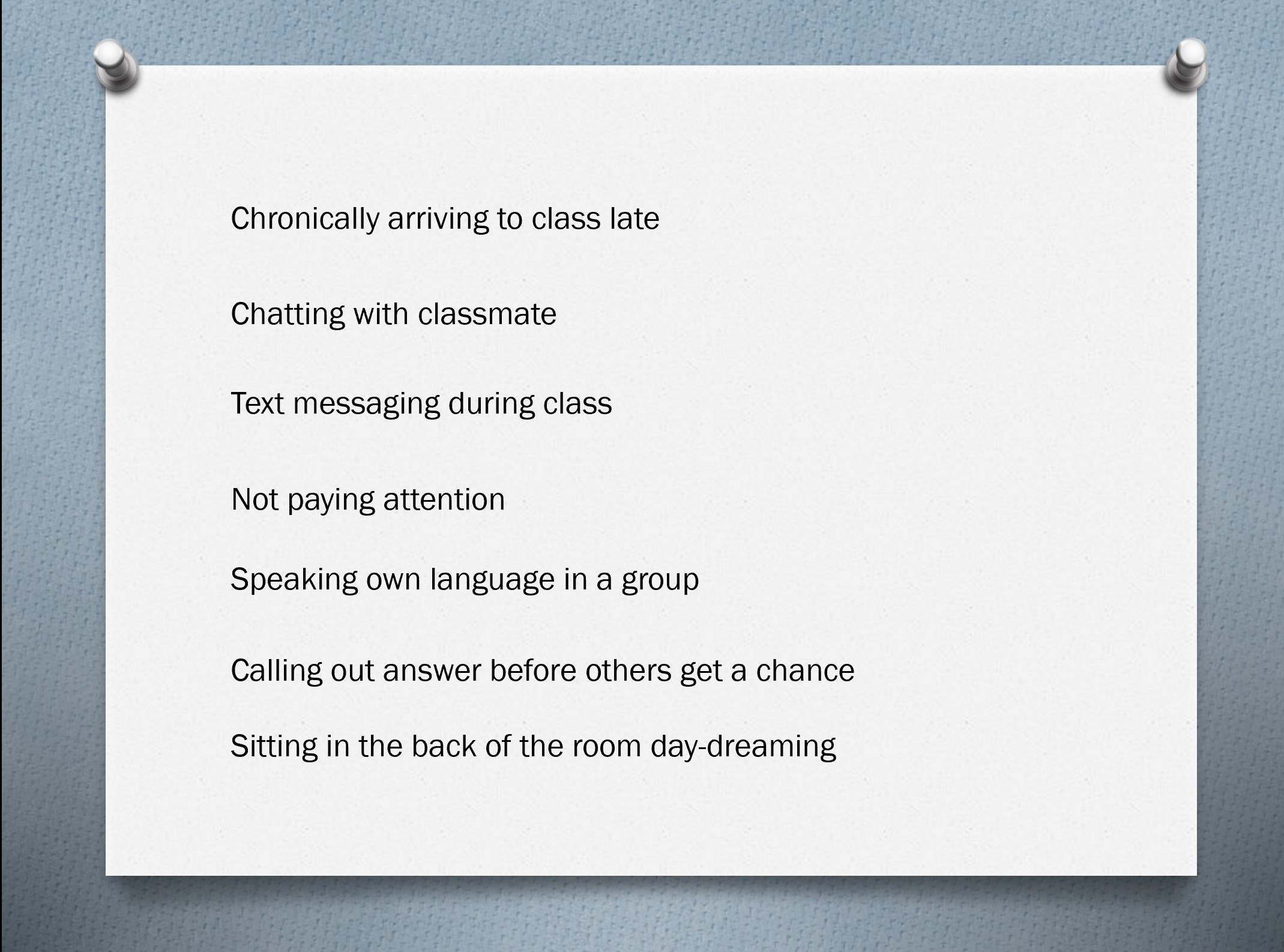
Most ESL students don’t do goofy things just to irritate the teacher. Usually, they are unaware of how they are coming across or not aware that they are acting differently from the other students or even what is expected of them.  These are some of the habits students tend to bring to our classes:

  • Chronically arriving to class late
  • Text messaging during class
  • Not paying attention
  • Chatting with classmate
  • Not participating in a group
  • Calling out answer before others get a chance
  • Sitting in the back of the room day-dreaming
  • No eye contact to teacher or classmates in a group
  • Speaking own language in a group
  • And more

To circumvent these habits and help students develop an awareness of expectations, in the two most recent ESL programs that I’ve taught in, we included some skits during our orientation of new students or during a workshop for students after the term had started. Not only did the students seem to enjoy them, but also we noticed far fewer students coming to our classes with these behaviors.

Here is how we did it.

Continue reading