Author Archives: commonsenseesl

• The Writing Workshop: Countless Benefits for ESL Students and Teachers

Cover workshop revisited Shot

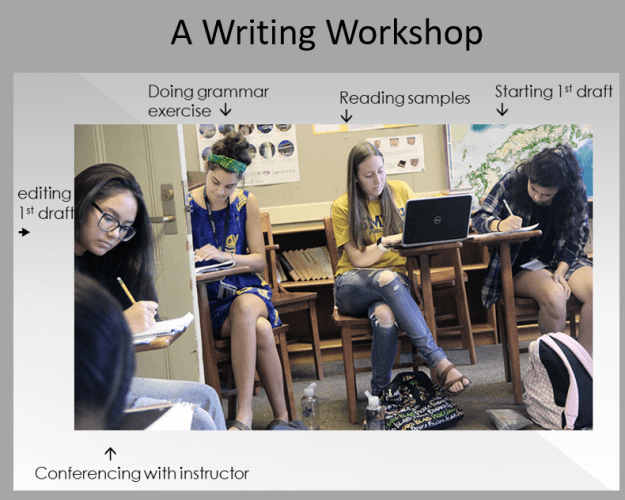
This posting includes sample lessons of a Writing Workshop that give students a lot of autonomy.*

This posting is an update of my February 1, 2019 post:  Most Important Motivator of Students: How You Can Do It

Since posting this back in 2019, I’ve heard from teachers who decided to try out a Writing Workshop with their ESL Writing classes even though they were skeptical at first. Their hesitation seemed to be doubtful that their students would actually be productive without more direct teacher control. However, they reported that their initial skepticism was quickly dispelled after seeing the same great benefits that I had described in the post below. Almost all of them stated that they couldn’t imagine teaching a Writing class in any other way in the future.

Here is that posting.

Continue reading

• Developing Paraphrasing Skills: Oral Paraphrasing Before Written.

Cover paraphrasing shot

(This posting includes a handout which you are welcome to use with your students.) *

YouTube I discuss this posting in this video: Developing ESL Paraphrasing Skills Naturally: Start with Oral Paraphrasing Exercise

A good paraphrase can demonstrate to the teacher that the student truly understood the source. And if it is clearly written in the student’s normal style and level of vocabulary, the teachers can feel reassured that the writer wasn’t plagiarizing.

Paraphrasing may be a new concept for many of our ESL student. However, we can help them understand how to do it in a way that will let them “experience” what a good paraphrase is through a very natural process.

Continue reading

• A Simple Technique for Writing Focused, Short Answers and Paragraphs on Tests

Cover essay questions shot

(This posting includes a handout which you are welcome to use with your students.) *

Advice from academic instructors: Give your ESL / ELL / International students practice writing short paragraph answers to test questions.

Academic instructors report that these types of questions tend to cause problems for our students:

  1. They are unable to finish within the time limit.
  2.  They don’t actually answer the questions.

Here is a simple technique that students can use which can actually resolve those two issues.

Continue reading

• Memorizing: Not the Optimal Approach to Learning ESL

Cover surprised shot

(This posting includes a handout which you are welcome to use with your students.)*

This posting is an update of a post from September 2019: Mistake: He surprised to see it snowing. (Adjectives that look like verbs)

Back in my high school days, learning my first foreign language, French, I remember often hearing the teacher say, “You’ll just need to memorize this.”

Fortunately, the art of teaching foreign languages, including ESL, has come a long way from those “just memorizing” days. We understand the importance of comprehensible input and the effectiveness of engaging with new concepts and vocabulary in multiple contexts.

To illustrate this, I’d like to refer to a posting from 2019, in which I discussed a common mistake that ESL students make with adjectives that look like verbs. Instead of telling students that they need to memorize these words, we lead them to internalizing these though a series of four exercises. By the end of these, students tend to remember because the words“sound” right rather than wracking their brains searching for what they had been told.

When students see an –ed at the end of a word, they tend to automatically assume it’s a verb, and this assumption can lead them to grammar mistakes.

(* mistakes—These sentences are missing a verb.)
*Kai embarrassed during his speech.
* Rumi interested in horses.

To help students in the most efficient manner, I will sometimes paint with a broad brush.  So I simply tell my students that these words are adjectives: surprised, embarrassed, confused, interested and shocked. They need a verb with them.

(correct): Kai was (v) embarrassed (adj) during his speech.

Avoiding unnecessarily complicated information

It’s true that those words can be can be used as verbs, for example:
– It embarrassed (v)  Kai that he forgot some of his speech.

But in all my years of teaching writing, I rarely see students use them that way. They almost always use them as adjectives, so I don’t waste their time/mental energy talking to them about using these as verbs. Instead, I just generalize and tell them that they are adjectives.

Four-step exercises to teach these to students (Handout included.)

Continue reading