Author Archives: commonsenseesl

• Best Subject for an ESL Integrated-Skills Class (Part 1 Overview) REVISITED

Cover Part 1 overview shot

This post may sound like I am contradicting a previous post,Integrated vs Discrete Skills ESL Courses: Advantages of Discrete Skills   Despite my support for segregated skills in general, an integrated skills course with higher-level students who are more homogeneous in ability can be effective and practical.

For an integrated skills 1 course to be effective and engaging to the students, the subject should be something which is inherently appealing to the majority of the students.  After all, the students will be spending the course time reading, writing, and talking about the subject.

One subject which has been enthusiastically received by both students and instructors is culture, and more specifically, differences in cultures and the reason for these differences.

Some examples of these differences are:

-Why are people in western cultures more likely than people from Eastern cultures to smile at a stranger standing at a bus stop than?

-Why do people in some cultures tend to be less direct in saying their opinions than in other cultures?

-In a study of 4-year-olds, why did the Asian children spontaneously share their candy with another child but the American children only reluctantly share when asked?

Continue reading

• Short, High-Interest Articles for Extensive Reading: # 5: “Complaining: Sometimes Good, But Sometimes Bad ”

Screenshot (1405)

(This posting includes a handout LINK AT THE END OF THIS POST which you are welcome to use with your students.) *

Complaining to a friend about something can often become a part of everyday conversation. Perhaps it’s about a teacher’s style, or about the pay at a job, or about the food in the school cafeteria, or about someone you both know.

Researchers have studied the reason why complaining is so common, what benefits it might have, and the problems it can cause the complainer. Also, the researchers looked at ways that we can learn to complain more effectively.

Complaining can actually become a pattern among friends, classmates and co-workers. For example, Allie had a part-time job as a waitress that she enjoyed after classes.The restaurant was supposed to close at 9 p.m., but recently the manager was letting customers enter later than that. This meant that the staff (waiters, waitresses and cooks) often couldn’t leave unit 10 or 10:30 p.m. or later.  This became the most common topic of conversation among the staff members as they were leaving and later in text messages.  (See complete article below.)

For background information about these articles and for suggestions for how to use them with your students, see  • Introducing “Short, High-Interest Readings”  Also, I’ll be adding more of these articles in the right-hand column: ESL Reading> Short, High Interest Articles for Extensive Readings

Here is the fifth article. You can download the article for your students by clicking on the link at the end. Also included are three optional exercises: True-False Questions; Paraphrasing Exercise; Reflection Exercise.

Continue reading

• The Writing Workshop: Countless Benefits for ESL Students and Teachers (REVISITED)

Cover workshop revisited Shot

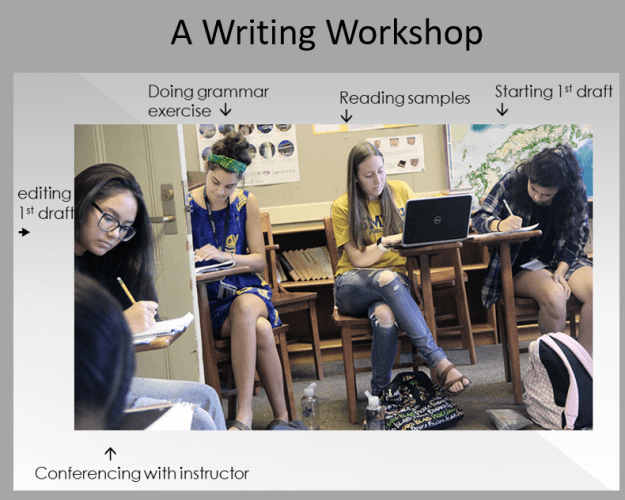
This posting includes sample lessons of a Writing Workshop that give students a lot of autonomy.*

This posting is an update of my February 1, 2019 post:  Most Important Motivator of Students: How You Can Do It

Since posting this back in 2019, I’ve heard from teachers who decided to try out a Writing Workshop with their ESL Writing classes even though they were skeptical at first. Their hesitation seemed to be doubtful that their students would actually be productive without more direct teacher control. However, they reported that their initial skepticism was quickly dispelled after seeing the same great benefits that I had described in the post below. Almost all of them stated that they couldn’t imagine teaching a Writing class in any other way in the future.

Here is that posting.

Continue reading

• A Surprisingly Simple Quality that Students Want in Their Teachers

Screenshot (1406)

It was early in my teaching career, and I had recently started teaching for the first time in Asia. My students were a total pleasure to work with. But I wondered what they were looking for in me, their teacher. The director of our program seemed like a thoughtful Asian man, so I believed that he could give me some insights. I wasn’t disappointed.

What he told me seemed so simple, but the more I thought about it throughout my teaching career, the more impactful it became. Also, when I reflected back on the characteristics of my favorite teachers in the past, his insight was spot on.

Here is what he told me when I asked him, “What are students looking for in their teacher?”

Here is what he told me in one simple sentence when I asked him, “What are students looking for in their teacher?”

Continue reading