
At the end of the term, the Level 3 Writing teacher Pam (not her real name), was filled with turmoil. She had shared samples of her students’ papers with our Writing Panel (a group of five Writing teachers.) After reading the papers, the members felt that four of her students’ writing skills hadn’t developed enough to pass to the next level. Thus, the members recommended that those four repeat Level 3.
Pam acknowledged that the students’ skills were weak and said that two of them were expecting to fail. However, the other two would feel shocked.
At the beginning of the term in September, Pam liked to give students high grades on assignments. She was worried that low grades would discourage them. As the term progressed, she continued to score high those students who made a good effort, thinking that would keep them motivated. But now it was December, and she was caught in a dilemma: either pass those two students who would struggle greatly in the next level or shock and disillusion them with the news that they had failed.
In his book, Punished by Rewards, Alfie Kohn, discusses meaningful perspectives about and approaches to giving grades. By incorporating many of her ideas, we can avoid the pitfall that this Writing teacher had fallen into.
One piece of advice from Kohn is, “Never grade for effort.” Pam, the Writing teacher, acknowledged that on early assignments, most students got good grades even if they hadn’t demonstrated the expected skills. She hoped that the good grades would incentivize them to continue to make an effort to do the assignments. However, in the end, passing or failing the class would be determined by the students’ writing skills, not on how hard they work.
How to keep students motivated even if their skills are weak early in a term.
Kohn recommends, “Even if you must come up with a grade at the end of a term, limit the number of assignments for which you give a letter grade or number grade, or better yet, stop the practice altogether.” This can be effective as long as we are willing to give some feedback on daily assignments instead of a grade or points. And doing this doesn’t need to be onerous for the teacher. (See • Don’t Give Points. Give Green Instead. Save Time from Counting and Recording Points. and Getting Back Up with ESL Paperwork: Effective Solution
Then on the major assignments (e.g. essays) that will be used to determine whether or not they have the skills necessary to pass the course, we can include points or grades along with other feedback. Also, we can include a condition for getting these grades: they must have finished all the daily assignments. That condition is very effective for motivating students to do all their assignments. To demonstrate, here is how a grade book would look.

Incentive Without Punishment
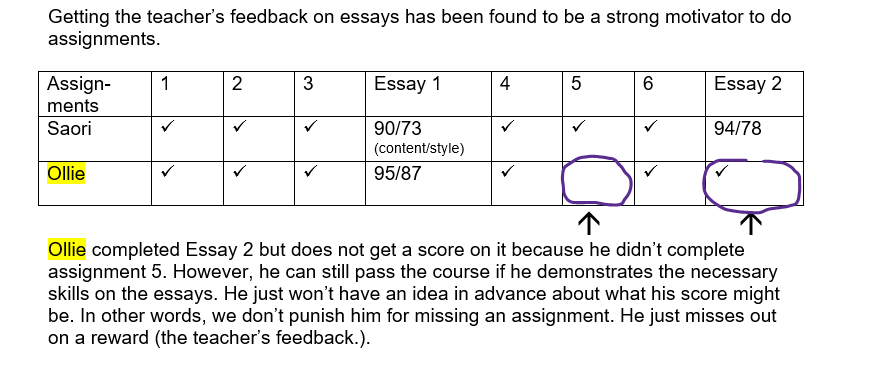
Here is the beauty of this approach.
We haven’t painted ourselves in a corner. If Saori’s grammar skills don’t improve enough to justify passing her to the next level, we don’t need to feel anxiety about telling her that she needs to repeat the course.
At the same time, if we see that Ollie has the necessary skills to pass at the end of the course, we can justify passing him based on those skills, not on whether or not he did homework assignments.
No arguments, no nagging about missing homework assignments
If a student like Ollie continues to miss daily assignments, we can remain emotionally calm. We merely ignore the grade part of his essays. We can maintain a professional standard by still marking the content and grammar on his essay; we just withhold telling him what grade he would have received on that essay (unless he has a good excuse of missing that assignment or he makes it up.) In fact, it very rare for a student who has not received a grade on an essay due to a missed assignment to miss another assigment.
See • Most Effective Technique for Marking Grammar on Essays to Develop Self-Editing Skills
In sum, we can keep students motivated and upbeat even if their early grades aren’t so stellar or if they tend to slack off at times.
David Kehe
Faculty Emeritus
 Common Sense Teaching ESL