Tag Archives: positive feedback

• Semi-Colons Can Actually Be a Useful Tool for ESL Students

screenshot-1462

Hey, David. Did you notice the two semi-colons that I used in my essay?” Alvin asked me as he entered the classroom.

It’s easy to think that ESL students can live without semi-colons. However, after doing a brief lesson with them, I found that they not only can understand what they are, but also, how useful they can be.

As an introduction to semi-colons, I explain just three general points:

Continue reading

• LINCS Topic 3: What can you recommend for offering effective feedback on writing? How can teachers manage the amount of time it takes to give feedback?

Cover 3 Feedback REV

(This posting includes a handout which you are welcome to use with your students.) 

This posting is a more detailed response to my interview question on Day 3 .LINCS Discussion: Student-Centered Approach to Teaching Writing Skills. .

Below in blue, you’ll find the details that I’ve added to the Day 3 LINCS’ posting.

Giving feedback to students on their writing is such a rewarding aspect of our job.

However, it’s important to do it in a way that is meaningful to students yet user-friendly for the teacher. Here is how we can do it.

Giving meaningful feedback in in a manner that is time and energy efficient

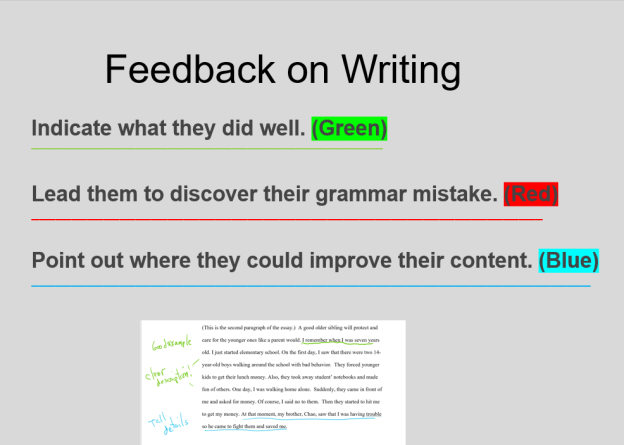
In general, we’d like to give three types of feedback on a piece of writing:
1) Indicate what they did well.
2) Lead them to discover their grammar mistakes.
3) Point out where they could improve their content.

1) Indicate what they did well.

Imagine that you are a student and just received your paper with this positive feedback from the instructor at the end of the essay:

This was a good essay.  Your ideas were interesting.  You used advanced sentence styles, and some of your examples helped me understand your main points.

Will these comments actually help you, as a student, apply how you wrote to future writing tasks?  Which specific ideas were interesting?  Which specific sentences was the teacher referring to as advanced and which examples were helpful?

A time-consuming alternative that some teachers turn to is to write the comments in the margin next to noteworthy places in the essay.  The drawback to this, especially when commenting on paper, is that it is time consuming, there is little space to write them, and the handwriting needs to be clear.  Also, one wonders whether students will actually read the comments.

Before describing an easy, efficient and effective method for giving focused positive feedback, it’s important to understand the reason why we want to give positive feedback.  What we are trying to do is to encourage them to continue to use writing techniques which have made their writing assignments coherent, cohesive and interesting.

This means we’d like to point out, for example, where they have effectively used…

Continue reading

• LINCS Topic 2 What instructional strategies have you found to be motivating for English learners? 

Cover Motive Blog June 2023 REV

(This posting includes a handout which you are welcome to use with your students.) 

This posting is a more detailed response to my interview question on Day 2 .LINCS Discussion: Student-Centered Approach to Teaching Writing Skills. .

Below in blue, you’ll find the details that I’ve added to the Day 2 LINCS’ posting.

I have found six ways to motivate students.

1) Give Students Autonomy

According to psychologist Edward Deci, the most important ingredient for motivating students is autonomy. 1

Having autonomy doesn’t mean that students decide what is taught in a lesson.  Instead, students can experience autonomy if the lesson is set up so that they can individually choose which exercise to do first, second etc., how fast to work, when to ask the teacher a question or for help and even when to take a break.

A writing-workshop approach is an excellent way to give students autonomy. Here is how it can be done:

Step 1) The teacher briefly explains the assignments that student will be working on during the class.

Step 2) S/he returns any homework assignment that students had turned in and which the teacher had marked. They will correct these and show the teacher, but they DO NOT start writing yet.

Step 3) If there is a group-activity, the students do that.  As each group finishes, they don’t have to wait for the others to finish.  Instead, they start the assignments from Steps 1 and 2 individually.

Step 4) AUTONOMY!  Students start the assignments by individually choosing which one they want to do first, second, third.   At any time, they can ask the teacher any questions they might have and show him/her corrections from the returned assignment.

Some of the benefits of the Workshop

Continue reading

• Discussion: Student-Centered Approach to Teaching ESOL Writing Skills

LINCS invite blog shot

During the week of March 6-10, I was interviewed online (in written form) about teaching writing skills in the LINCS’ “English Acquisition” Discussion Group.

LINCS (Literacy Information and Communication System) is a division of the U.S. Department of Education. In addition to discussion groups, it contains many resources for teachers.

Each day of the week, the interview was focus on a different aspect about teaching writing to ESOL students, including how to motivate students and how to provide meaningful feedback.

Continue reading