
Tag Archives: positive feedback

• I Stopped Trying to Catch AI Plagiarism. Here’s What I Do Instead.

Dealing with students who plagiarize now seems like a piece of cake compared to ones who now use AI to write their papers. I could usually deter students from plagiarizing by demonstrating how easy it is for teachers to find it.

Early in a term, I would show this paragraph that may have been written by a student:
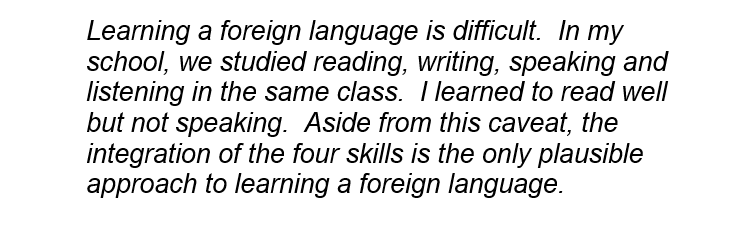
I’d ask them if they thought the writer had copied any of the sentences from a source. Unsurprisingly, they always spotted the last one. It was a clear signal: if a student can identify it, a teacher definitely can.

However, the rise of AI has shattered that approach.

Why the old technique doesn’t work anymore

Now, I can no long claim that it’s easy to find plagiarism using the sentence, “Aside from this caveat….” If a student plugged that into AI, it could come out as, “Even with this problem, I still think that learning the four skills together is the best way to study a foreign language.”

The vocabulary is simpler, the tone is conversational, and it is incredibly difficult to prove the student didn’t write it themselves.

According to reports from NPR and other outlets, many schools are spending thousands of dollars on AI-detection software. Yet, research shows these tools are far from reliable and frequently produce false positives. Few things are more discouraging for students than working hard on a paper and then being accused of not writing it themselves.


The “Incentive” Approach

Continue reading

• Writing class: Easy, focused, POSITVE feedback on essays. (REVISITED)

victory

“Good style!”

Many instructors want to not only point out errors on students’ papers but also encourage them with positive comments about what they did well.  Unfortunately, it can take a lot of time writing out these comments with clear handwriting, and it involves mental energy trying to formulate what to say in a way that students can understand.

There is a method for indicating specifically what the student did well on any writing task, which takes little time on the part of the instructor and results in improved writing in the future.

Continue reading

• ESL Students’ Positive Responses to this Teacher Technique (REVISITED)

success

          “I feel proud of myself when I see these.”

         “They are helpful because I feel that you are encouraging me and understand what I’m writing.”

These are two of the comments students wrote in response to my survey question: “On your essays, I underline in GREEN words, expressions, sentences, ideas, details and examples that were good.  Are these GREEN underlines helpful to you?”

Most Writing instructors like to give students positive feedback on their essays in addition to indications of where they have grammar mistakes or where they have content problems.  These positive comments often are in the form of a message at the end of the essay.  However, there are a few problems with giving feedback in this end-of-the-essay manner.

First, it takes time and extra mental energy to write these in a style that will be meaningful to students.

Second, they are usually too general to be of much use for students to apply to future writing assignments.

And third, it requires the teacher to write with clear handwriting, something that many of us don’t have a talent for.

In one program, on their essay rubrics, they now “include a section where students can earn points for successful language use rather than being strictly penalized for only misuses.”  This is admirable, but it (1) involves extra work and calculations for the teacher and (2) doesn’t specify exactly what the student did successfully in the essay.

The technique of using green underlines is very user-friendly time-wise and energy-wise for the teacher to use. 

Continue reading

• Most Important Tool for Managing Classroom Behavior (Case two and Caveat) REVISITED

Classroom management

“David, Please report to the Director’s office as soon as your class finishes.  He needs to talk to you.”  A program assistant handed me a note with those sentences on it.  Gulp!

In the early 1980s, my wife and I, without much thought, accepted teaching positions on the Greek island of Lesbos.  It was a Greek island, so what could possible go wrong?

It was a prep school that high school students attended in the late afternoons/evenings after high school to study English.  Shortly after arriving, we met one of the teachers whom we were replacing.  He told us that the school had a lot of discipline problems because many of the students didn’t want to be there.  He said that the teacher-turnover was quite high as a result.  In fact, a couple of teacher had just disappeared a few months earlier.

On the first day of class, as we walked down the hallway, we could see students literally chasing each other around the class rooms and jumping on the desks.  My first class was with 16 tenth-grade students.  Although most of the students paid little attention to me but instead continued to chat as I started the lesson, there were three female students sitting in the front row appearing eager to begin.  Those three became the focus of my attention.  Gradually, most of the others started to engage in the lesson, while a couple slept or doodled or looked out the window.

Continue reading