Tag Archives: cultural misunderstanding

• Best Subject for an ESL Integrated-Skills Class (Part 1 Overview) REVISITED

Cover Part 1 overview shot

This post may sound like I am contradicting a previous post,Integrated vs Discrete Skills ESL Courses: Advantages of Discrete Skills   Despite my support for segregated skills in general, an integrated skills course with higher-level students who are more homogeneous in ability can be effective and practical.

For an integrated skills 1 course to be effective and engaging to the students, the subject should be something which is inherently appealing to the majority of the students.  After all, the students will be spending the course time reading, writing, and talking about the subject.

One subject which has been enthusiastically received by both students and instructors is culture, and more specifically, differences in cultures and the reason for these differences.

Some examples of these differences are:

-Why are people in western cultures more likely than people from Eastern cultures to smile at a stranger standing at a bus stop than?

-Why do people in some cultures tend to be less direct in saying their opinions than in other cultures?

-In a study of 4-year-olds, why did the Asian children spontaneously share their candy with another child but the American children only reluctantly share when asked?

Continue reading

• Going Beyond Learning Language Skills in ESL Courses.

Cover Integ Revised going beyondIt’s understandable that ESL teachers would like to include something more than language-skill development in their courses. However, this desire can become a mission which can override the real needs of the students.
Teachers who have a passion about a topic, for example, the environment, social justice, animal rights, racism, and technology, can feel, as one colleague explained, “This topic is very important for all students to know about.” This can lead to a theme for a course in which the focus of each lesson is about that topic as students read, write and talk about it and learn the specialized vocabulary connected to it.

A problem can arise when the theme starts to overshadow skill building. For example,
when working on reading skills, if a reading passage has “important” content but is above the students’ reading levels, the teacher will “orally” explain what they read. Students are evaluated on how much they knew about the content rather than on their language-skills development.

As another example, if the conversation or discussion skill that is supposed to be developed during the course isn’t naturally applicable to the theme, it may not be practiced.

Teachers at the next level might find students with a lot of knowledge about causes of air pollution or the challenges of recycling or discrimination in hiring practices or the potential of AI or social media, but weak language skills.

Fortunately, it doesn’t have to be an either-or situation; in other words, we don’t have to choose between skill development or content.

Engaging content and skills development. It is possible to have both.

Continue reading

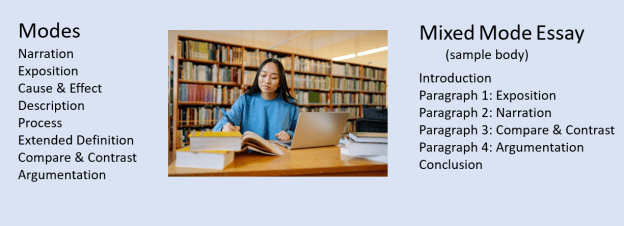
• Why We Teach the Modes in ESL Writing Courses and a Mix-Mode Essay

Cover Modes shot

(This posting includes a handout which you are welcome to use with your students.)

I was left speechless after reading Sayo’s essay. I didn’t know where to start because I couldn’t figure out exactly what she was trying to say.

When I asked her how a specific detail was connected to her topic, she said that she purposely didn’t explain that because she was showing respect to the readers who would figure it out without her explicitly saying it.

I also asked her about why she included an unrelated personal experience. She responded that she thought it would make her paper more interesting to read.

She concluded with a vague question that she hoped would give the reader something to ponder. It only left me pondering how the question was related to her essay.

I realized that Sayo’s essay demonstrated a cultural difference with regard to reader- versus writer-responsibility.  Apparently, English is a “writer-responsible” language; as such, it is the writer’s job to communicate ideas clearly to the reader.  On the other hand, in “reader-responsible” languages, (like Sayo’s) the burden is on the reader to understand what the writer is trying to say.  In reader-responsible cultures, it is presumed that the writer already shares with the reader certain knowledge that can, thus, be left unsaid. However, since readers in English are not accustomed to that role, frustration and communication breakdown can result.

What researchers have found about other cultural differences in writing papers.

Continue reading

• Starting and Ending a Conversation (Includes a Group Mixer Activity)

Cover Lrg start conv shot

(This posting includes a POWERPOINT presentation and HANDOUTS which you are welcome to use with your students.)*

“I wish I had more chances to practice my English outside of class.”

“How can I meet some native-English speakers?”

“I went to a party last weekend. There were about 20 people there, but nobody seemed to want to talk to me. I just kind of stood in the corner looking at my cell phone. Why didn’t anyone talk to me?”

“I sat next to someone, and I wanted to talk to him, but I was afraid that I would be bothering him, or he wouldn’t say anything. What do you think?”

I’ve been asked these types of questions frequently by my students.  Naturally, some of them were low-level students with little confidence in their skills, but surprisingly, often more fluent ones also asked me for advice.

For students from some cultures, starting a conversation with someone they don’t know might be a new concept to them. (See Best Subject for an ESL Integrated-Skills Class (Part 2 of 4: Reading aspect) 

Exercises for starting-a-conversation skills Continue reading