Tag Archives: activities

• Motivating Students Through Flow Experiences

It was a teacher-experience that I would have paid good money for. My students had been working individually. With one minute left in the class, I softly told them that it was time to stop for the day. Some of them sort of jumped when they heard my voice and looked at the clock. Then a few of them slowly started to pack up their stuff. But most of them continued to read and write, finally standing up a few minutes later.

On my way home, reflecting on what I had just observed in that class, I realized that my students were probably in a state of flow. Deconstructing the lesson, I noticed that it contained many of the characteristic that researchers say promote flow. And after seeing my students’ responses, I became determined to apply as much as I could to future lessons. And that is what I have tried to accomplish in the sample activities below.

Why should we care about flow? Research has found that people who reportedly experienced flow in an activity tend to spend more time doing it and do it better. Also, they do it for intrinsic reasons; in other words, they felt enjoyment and satisfaction from the activity itself.

My students who seemed to have been in a flow state were probably experiencing characteristic described by researchers. They lost a sense of time; what they were doing seemed effortless; and they were especially focused.

Setting up activities to encourage flow experiences Continue reading

• Writing Class Person Description Activity: Fun, Lively and Productive (Revisited)

Cover secret classmate shot

(This posting includes a form which you are welcome to use with your students.) *

YouTube This posting is discussed on my YouTube video ESL Writing Class Activity: Fun, Lively and Productive
This is a paragraph that a student secretly wrote to describe one of her classmates.  All the students are circulating around the periphery of the room, reading description hanging on the wall with no names on and trying to determine who is being described in the paragraphs.  Each student seems very focused on reading the descriptions, searching for the classmate who is the object of the description but also looking out of the corner of their eyes to see what kind of reaction others are having to the description that they secretly wrote.  There is energy in the room, a lot of interacting and a lot of laughing.

Describe your classmate activity

In brief, the steps for this activity are:

Continue reading

• Another Conversation Activity: Listen to Partner and Ask Questions to Complete Information-Gap Chart (REVISITED)

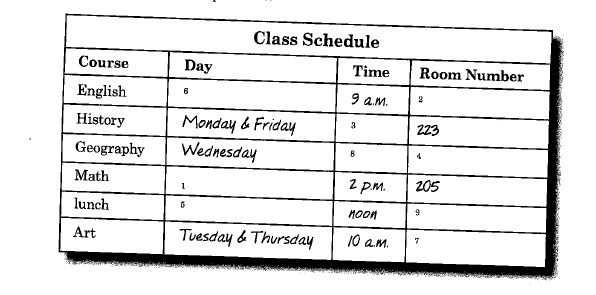
image schedule chart

(This posting includes a handout which you are welcome to use with your students.)*

At first, this pair-work activity looks like it’s about getting students to talk a lot by filling information in a chart.  But that’s not the most important value of it.

Yes, students will talk a lot during this.  But by including a short pre-exercise, they will see how they should ask clarification questions when they need more information or if they didn’t understand.  Asking clarification questions is the strategy that they can use in future conversation situations in and outside the classroom.

In this activity, the students will be filling in information about a class schedule.  They’ll need to listen to their partners tell them the name of courses, days, times and room numbers.  They’ll have many chances to ask questions, especially if they don’t understand.

There are three steps in this activity:

  • Step 1: Brief work with a model showing how to do Step 2.
  • Step 2: Pair activity (Student A/ Student B)
  • Step 3:  Exercise to do if they finish before other pairs have finished.

Continue reading

• Fluency Writing: Reading, Speaking In Triads, And Listening Culminating In A Writing Task (REVISITED)

Cover fluency shot

                                          Integrating the four skills

(This posting includes a handout which you are welcome to use with your students.)*

This is the perfect activity for integrating four skills into one activity.  And it culminates in a writing task in which students focus on controlling their grammar and on their sentence style.  It’s also one in which students can practice those two aspects of writing without having to spend time thinking about what to write.

These fluency activities can be used throughout a term when instructors would like to have students work on their grammar in a writing context and/or when they would like to add some group work in their writing classes.  Also, it’s a good lead-in to teaching paraphrasing skills.

Continue reading