Category Archives: *MOTIVATING ESL STUDENTS AND TEACHERS

These posting include techniques for motivating ESL students and perspectives for motivating teachers.

• Discussion: Student-Centered Approach to Teaching ESOL Writing Skills

LINCS invite blog shot

During the week of March 6-10, I was interviewed online (in written form) about teaching writing skills in the LINCS’ “English Acquisition” Discussion Group.

LINCS (Literacy Information and Communication System) is a division of the U.S. Department of Education. In addition to discussion groups, it contains many resources for teachers.

Each day of the week, the interview was focus on a different aspect about teaching writing to ESOL students, including how to motivate students and how to provide meaningful feedback.

Continue reading

• In-Class Essays: More Important Than Ever

Cover ICE shot

(This posting includes a PowerPoint which you are welcome to use with your students.) *

As I was reading Elio’s two-page essay, I was amazed at how good it was. In fact, it seemed too good, way better than anything he had ever written.  Although I was sure someone else had written it or had given him extensive help with it, or it had been downloaded from the internet, I couldn’t prove it. When I mentioned to him that it was so different from his previous papers, he just smiled and said that he had worked very hard on it over the past two weeks.

It would be a travesty to pass a student like Elio based on his out-of-class essays (OCEs). From reading most of his assignments, I was confident that he did not yet have the skills to be successful in academic classes, especially English Comp. Also, our higher-level ESL courses would lose all credibility in the eyes of the campus if unprepared ELL students were being allowed to take their courses.

According to research, because of the ease with which all students (not only ELLs) are able to download essays and plagiarize, more and more academic instructors are basing a large percent of their students’ grades on their performance on in-class papers written under a time limit. Thus, instructors have recommended that we include in-class essays (ICEs) in our ESL courses.

Reasonable expectations for in-class essays.

Continue reading

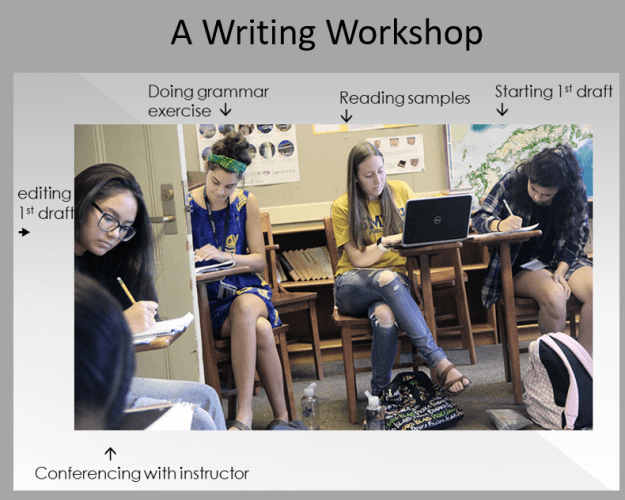
• The Writing Workshop: Countless Benefits for ESL Students and Teachers

Cover workshop revisited Shot

This posting includes sample lessons of a Writing Workshop that give students a lot of autonomy.*

This posting is an update of my February 1, 2019 post:  Most Important Motivator of Students: How You Can Do It

Since posting this back in 2019, I’ve heard from teachers who decided to try out a Writing Workshop with their ESL Writing classes even though they were skeptical at first. Their hesitation seemed to be doubtful that their students would actually be productive without more direct teacher control. However, they reported that their initial skepticism was quickly dispelled after seeing the same great benefits that I had described in the post below. Almost all of them stated that they couldn’t imagine teaching a Writing class in any other way in the future.

Here is that posting.

Continue reading

• How We Can Develop Intrinsic Motivation in Our ESL Students. Specific Examples. (Part 2)

REV Cover Intrinsic Pt 2

As I mentioned in Part 1, it is possible for our ESL students to be intrinsically motivated to learn English.  And there are ways that we can help them develop this. I discussed the first two recommendations based on research: 1) Give Students Autonomy and 2) Explain the Purpose of the Assignment.. Here, in Part 2, I explain the other three recommendations along with specific examples.

 According to research, how we can promote intrinsic motivation.

Continue reading