Category Archives: *MOTIVATING ESL STUDENTS AND TEACHERS

These posting include techniques for motivating ESL students and perspectives for motivating teachers.

• Integrated vs Discrete Skills ESL Courses: Advantages of Discrete Skills (REVISITED)

REVISIT COVER

For an extended discussion of this topic with links to some YouTube videos and downloadable exercises, see Four Part Series: Why, How And When to Teach ESL Integrated- and Discrete-Skills Courses. 

YouTube This posting is discussed on my YouTube video: YouTube about advantages of discrete-skills courses

After the first day at a college I had previously taught at, I noticed a long line of students outside our EAP (English for Academic Purposes) director’s office.  It was my first day teaching in this program, so, needless to say, I was curious.  It turns out these students all felt that they had not been placed in the right level.

I soon discovered that this was a common occurrence on the first day of each term in that program.

The courses in that EAP program were organized around integrated skills, so each student was placed into one of five levels for all five hours of instruction. 1 By the end of the first day, students were quick to notice that some of their classmates were weaker than they were in some skills (e.g. speaking) but higher in others (e.g. reading).  They also were aware that some of the activities during the course of the day, depending on the skill, were right at their level, but others were above or below.

It’s not too surprising that this would happen.  New students had been given a placement exam that tested multiple skills: reading, writing, speaking, listening and grammar.  The exam resulted in one score, and their level was determined by that one score.  That seemed to be the crux of the problem. 

Continue reading

• Most Important Tool for Managing Classroom Behavior (Case two and Caveat) REVISITED

Classroom management

“David, Please report to the Director’s office as soon as your class finishes.  He needs to talk to you.”  A program assistant handed me a note with those sentences on it.  Gulp!

In the early 1980s, my wife and I, without much thought, accepted teaching positions on the Greek island of Lesbos.  It was a Greek island, so what could possible go wrong?

It was a prep school that high school students attended in the late afternoons/evenings after high school to study English.  Shortly after arriving, we met one of the teachers whom we were replacing.  He told us that the school had a lot of discipline problems because many of the students didn’t want to be there.  He said that the teacher-turnover was quite high as a result.  In fact, a couple of teacher had just disappeared a few months earlier.

On the first day of class, as we walked down the hallway, we could see students literally chasing each other around the class rooms and jumping on the desks.  My first class was with 16 tenth-grade students.  Although most of the students paid little attention to me but instead continued to chat as I started the lesson, there were three female students sitting in the front row appearing eager to begin.  Those three became the focus of my attention.  Gradually, most of the others started to engage in the lesson, while a couple slept or doodled or looked out the window.

Continue reading

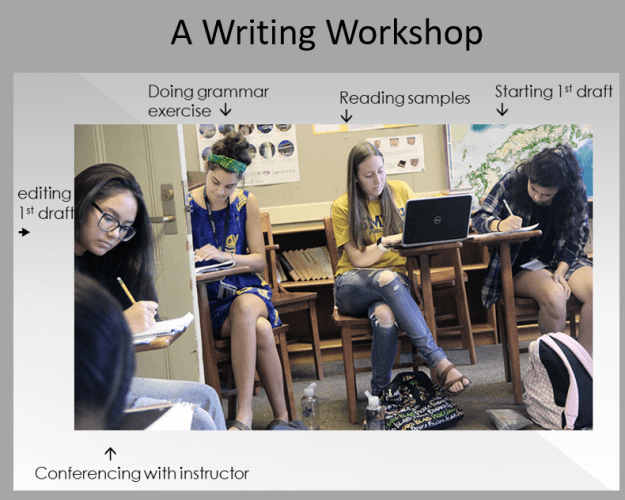
• The Writing Workshop: Countless Benefits for ESL Students and Teachers (REVISITED)

Cover workshop revisited Shot

This posting includes sample lessons of a Writing Workshop that give students a lot of autonomy.*

This posting is an update of my February 1, 2019 post:  Most Important Motivator of Students: How You Can Do It

Since posting this back in 2019, I’ve heard from teachers who decided to try out a Writing Workshop with their ESL Writing classes even though they were skeptical at first. Their hesitation seemed to be doubtful that their students would actually be productive without more direct teacher control. However, they reported that their initial skepticism was quickly dispelled after seeing the same great benefits that I had described in the post below. Almost all of them stated that they couldn’t imagine teaching a Writing class in any other way in the future.

Here is that posting.

Continue reading

• A Surprisingly Simple Quality that Students Want in Their Teachers

Screenshot (1406)

It was early in my teaching career, and I had recently started teaching for the first time in Asia. My students were a total pleasure to work with. But I wondered what they were looking for in me, their teacher. The director of our program seemed like a thoughtful Asian man, so I believed that he could give me some insights. I wasn’t disappointed.

What he told me seemed so simple, but the more I thought about it throughout my teaching career, the more impactful it became. Also, when I reflected back on the characteristics of my favorite teachers in the past, his insight was spot on.

Here is what he told me when I asked him, “What are students looking for in their teacher?”

Here is what he told me in one simple sentence when I asked him, “What are students looking for in their teacher?”

Continue reading