Category Archives: *MOTIVATING ESL STUDENTS AND TEACHERS

These posting include techniques for motivating ESL students and perspectives for motivating teachers.

• Advice: Don’t Say These 4 Things to Your Students

Cover Advice don't say these 4 things shot

YouTube This posting is discussed on my YouTube video Don’t Say These 4 Things to Your ESL Students

Everything that we say to our students can have a big impact.  For us ESL instructors that can be exhilarating, but it’s also a big responsibility.  Unfortunately, without realizing it, some instructors are sending the wrong message to students with “innocent” comments.  These are four statements that are in this category.

1) Teacher’s statement: The teacher doesn’t want students to feel stress, so just before handing out the quiz, she says, “This quiz will be easy.”
Message that students get: If a student starts the quiz and notices that it isn’t easy, he’s likely to think, “Wow!  I must be stupid.  This quiz is supposed to be easy.  My classmates probably know all this.”
What the message should be: This is what we can say instead to help them understand the purpose of the quiz: “This quiz will help us see how well you’ve developed your skills so far and what we’ll need to practice more.”

2) Teacher’s statement: The teacher wants to reward students, so he says, “You have all worked so hard this week, so I won’t give you any homework.  I want you all to just enjoy your weekend.”
Message that students get: “Homework is painful.  It just interferes with free time.  It’s best if we can avoid it.”
What the message should be: What we really want to do is give students confidence in our homework assignments, so we can say, “I’ve prepared a homework assignment that will lead you to developing your skills more.  It’s going to help you do well on our assignments  next week and in the class that you will be in next term.”

Continue reading

• Most Important Motivator of Students: How You Can Use It

Workshop Cover shot

This posting includes sample lessons that give students a lot of autonomy.*

YouTube This posting is discussed on my YouTube video ESL Writing Workshop Approach

The most important ingredient for motivating students is autonomy. 1 The sense of being autonomous can produce a very positive effect on students’ attitude, focus and their performance.  Best of all, it’s very effective and quite easy to include this in ESL classes.

Having autonomy doesn’t mean that students decide what is taught in a lesson.  Instead, students can experience autonomy if the lesson is set up so that they can individually choose which exercise to do first, second etc., how fast to work, when to ask the teacher a question or for help and even when to take a break.

A lesson plan template that gives students autonomy (Writing Workshop)

Teachers can organize their lesson in a Writing Workshop using many different types of materials, but it works best when using inductive exercises.  That is because inductive exercises require little or no time taken up with teacher lectures.

These are General Steps for a Writing Workshop and Sample Specific Lesson with handouts

Continue reading

• Most Stimulating and Engaging but Often Over-Looked Essay Mode

Cover Def Essay shot

(This posting includes a handout which you are welcome to use with your students.)*

A frequent type comment by teachers, “I always look forward to reading these essays.  They often give me new insights into my students and their cultures.”

A frequent type comment by students, “When I heard that we would write a complete essay about one word, I thought it would be impossible.  But after I chose a good word, I really enjoyed writing this.”

Another frequent type comment by students, “This was the most challenging essay for me, but in the end, it was the most rewarding.”

Many ESL Writing books and instructors overlook this essay mode because they don’t realize its secret potential.  It’s the Definition Essay.  The potential lies in the type of words that the students write about.

Traditional Definition essays can be very unstimulating for the students to write and for the teachers to read.  There are two major reasons for this:

(1) The category of topics from which to choose provides little opportunity for ESL students to feel truly invested in it.
(2) The students are given few specific or poorly designed techniques which they can use.

The Dynamic Definition Essay: Category of Topics and Specific Techniques

Continue reading

• Most Important Process that You can do for Yourself, Your Students, Your Program (Part 1)

Cover Most important process

This process will give you, your colleagues, administrators, and most of all, your students great confidence in what you and your colleagues are teaching your students.  It will serve as a legitimate basis for the goals and outcomes of your courses.

This empowering process is called a needs analysis.  It is one of the most important things I have ever done as a professional, and I’ve done this everywhere I’ve taught.

And on top of all that, it can be stimulating and rewarding to do.

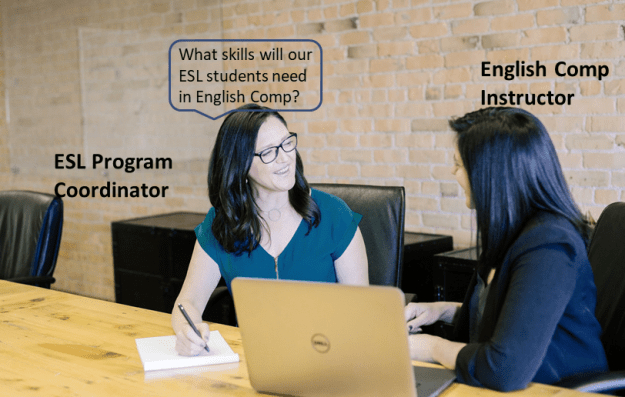
In brief, a needs analysis in an ESL context means finding out what skills students will need in order to be successful in the future.  The future can be the following term when they will be in the next level of a program; it can be when they finish their ESL instruction and will be in college courses (e..g. English Comp); it can be when they are traveling abroad; it can be when they enter the workforce.

These range from simple surveys of a small group of former students to more involved interviews with college instructors.

How to find out what skills students need to know once they leave our course or our program

Continue reading