Category Archives: * MAKING ESL TEACHERS’ LIVES BETTER

• Effective, Stress-Free Approach to Dealing with Plagiarism.

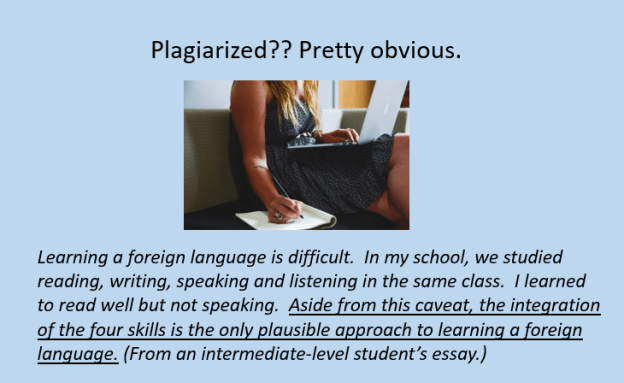
Cover plagiarized Revisit shot

This posting is an updated version of a post from November 2016: Writing Class: Dealing with Plagiarism (Don’t Take It Personally) 

In October 2016, Tiffany Martínez, a Latina student at Suffolk University in Boston, was accused of plagiarism by her sociology professor in front of the entire classHuffington Post plagiarism story   What caused him to be suspicious?  The word “hence.”  On her paper, he circled the place where she had written the word “hence” and wrote in the margin, “This is not your word.”

In my many years as an ESL instructor, I’ve witnessed instructors over-reacting in suspected plagiarism situations.  It seems as if those instructors were taking it personally, feeling like they were being disrespected.  Too often instructors seem to see it as a “gotcha” opportunity.

Plagiarism Learning Opportunities

Unless there is proof, the instructor shouldn’t accuse the student.  It would be more damaging to falsely accuse a students of plagiarizing who had worked hard than to “let” a students who actually plagiarized slip by.  If the student actually plagiarized, and the instructor has proof, it can be viewed as a learning opportunity.
Here are some options depending on the situation.

Continue reading

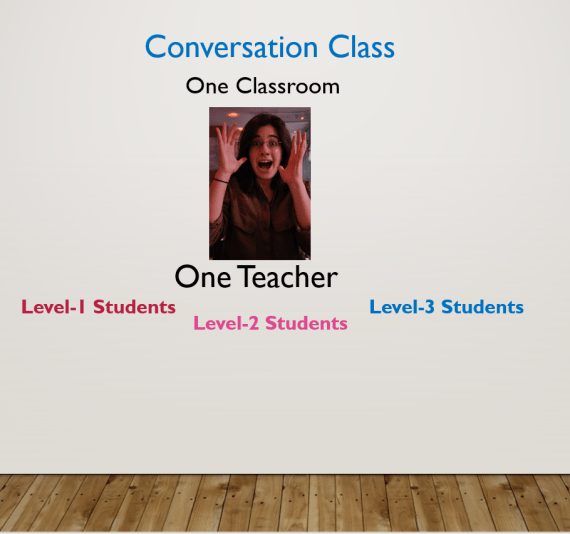
• Meeting A Conversation Course Challenge: Three Levels of Students, One Classroom, One Teacher

Cover multi level Shot

Having three levels of students in one classroom can be overwhelming. But for a reading-skills or writing-skills course, it seems relatively do-able because students can work individually on the reading or writing tasks.

However, for a conversation course in which students need to be interacting with classmates, it’s impossible right? No, it’s definitely possible.

Here is how it has been done successfully with a user-friendly approach for the teacher and with students developing their skills as they would in a single-level class.

Continue reading

• Don’t Give Points. Give Green Instead. Save Time from Counting and Recording Points.

Cover grade book shot

While working at my computer, I heard my officemate, Nadya, sigh. She had a stack of homework papers that she was in the midst of marking, counting points and recording. She told me that she was starting to feel burned out from all the paper work and wondered if I felt the same.

She showed me how she was evaluating her students’ homework. They had written 10 items, and next to each one, she had written points. For example, a 2/2 meant that the student did that item correctly, a ½ meant it wasn’t completely correct, and 0/2 meant it was completely incorrect.

That morning she was in the process of (1) totaling the points, (2) writing a score at the top, and (3) recording the scores in her grade book.  She said that she didn’t have time to write anything more specifically about the reason for the points on the students’ papers.

I then showed her a set of papers that I had recently marked. I don’t write points next to each item, but instead, I marked each with green or blue. Then I explained that by doing that, I’m able to specifically reinforce what they did correctly or point out what was incorrect. At the same time, I don’t need to write and record points, which saves me a tremendous amount of time.

Here are samples of our different approaches to marking assignments:

Continue reading

• Writing Your Own ESL Exercises: Two Basic Recommendations

Blog cover Write Own

When I first started to write my own exercises, I learned two simple but important steps the hard way. In this short, 5-minute video, I describe what happened when I did NOT include the two steps in a couple of exercise and how I was able to improve them.

Also, see • Recommended Treasure Chest for Writing Your Own ESL Materials

Here is the link to the video:

Continue reading