
Category Archives: * MAKING ESL TEACHERS’ LIVES BETTER

• Most Important Tool for Managing Classroom Behavior (First Case)

African classroom

(This posting includes a handout which you are welcome to use with your students.)

This “tool” has helped me remain calm in many stressful teaching situations.  Without this, I probably would have changed careers many years ago.  I discovered this tool during my first month of teaching ESL when I was in Africa in the Peace Corps.

Here is what happened that first time in Africa.  One day early in the term, I was conducting a lesson in a class of 35 students.  Sitting in the front row were two popular students, Kato (the class president) and his best friend, Abdula.  They were havig a good time privately whispering and laughing while I was explaining the lesson.  I could tell the other students had noticed them, so I knew I had to do something before the other students would start talking and I’d lose control of the class.  Because Kato and Abdula were popular, I knew that I could alienate the other students if I didn’t handle this situation delicately.  I could feel my stomach churning and blood pressure rising.   Probably many teachers would have had the same initial inclination that I had which would be to just tell them to stop talking.  But what if I did that, and they continued talking?  Then what could I do?   I decided to not say anything right then and to think about it after class.
Continue reading

• Don’t Wastes Students’ Energy Teaching Certain Types of Vocabulary Words in Reading Class

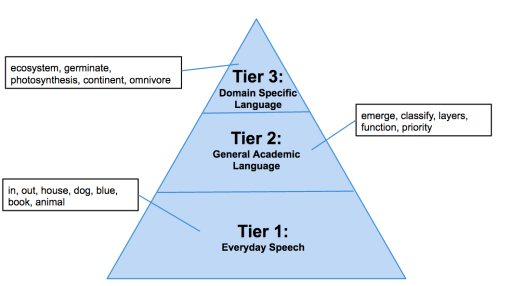
Three Tiers

“Radiance,” “strike a deal,” “gorgeous” “ecosystem.” In my 40 years of teaching academic ESL, I’ve probably seen these word in a reading passage at most only once or twice.  And I’ve never seen a student use them in a writing task.  And yet, these words were  included in several vocabulary exercises in a textbook, and students were asked to write sentences with them.  Because the words were in a reading passage, the author of the textbook, for some reason, decided that these were important words for students to study and try to internalize.

I think most of us would agree that spending time on a words so rarely used as “radiance” or “strike a deal” is probably not the best use of students’ precious time and mental energy if our true goal is to help them develop their reading skills.  At the same time, many of us who have studied a foreign language would agree that reading comprehension is enhanced by knowledge of a lot of vocabulary words.

At this point, two questions come to mind: (1) How do learners increase their vocabulary, and (2) which vocabulary words would perhaps be beneficial to study through exercises?

Continue reading

• Effective Approach to a Student Cheating (from Outside Research)

Cheating

Imagine this situation: During a quiz, you notice a student glancing at another student’s paper.  You feel that you need to take some action.

Surprisingly, there was a social psychology study conducted in a hospital setting that can help us know an effective way to approach this student.

For many of us, our first inclination is to confront the student tell him that if he continues to cheat, he will fail the quiz.  However, in his book The Originals, Adam Grant shows that explaining how someone’s behavior will negatively affect him or her is less effective than describing how their action will affect other people.

In the “hospital” study, to encourage doctors and nurses to wash their hands more often the researchers posted one of two signs near the soap dispensers in patients’ rooms.   One said, “Hand hygiene prevents you from catching diseases.”  The other said, “Hand hygiene prevents patients from catching diseases.” (Emphasis added.)  Over the next two weeks, a member of the hospital unit covertly counted the number of times the staff members washed their hands and a researcher measure the amount of soap used.

Interestingly, the first sign (“…prevents you…”) had no effect.  The second sign (“…prevents patients…”) had a significant impact on hand washing; it resulted in a 10% increase in hand-washing and 45% more soap usage.

How we can apply this study to ESL students who cheat on a test

Continue reading

• The Most Effective Classroom Organization for Reading Skills Development (Student-Centered)

Reading book

Here is what seems to be some well-kept secrets about reading classes.  The teacher doesn’t have to be the center of attention.  The teacher doesn’t have to “act” like a teacher, standing up front talking.

And most of all, students will not be bored or waste time if they are reading individually during class.

What students need from the reading teacher is someone who can help each individual student develop their reading comprehension skills.  A student doesn’t need to listen to a teacher explain to the class parts of a passage he/she already understands but that a classmate doesn’t.

Students can get the maximum benefits from a reading class and from a reading teacher through a reading workshop.  This student-centered workshop approach has proven effective at all levels and with students from over 40 countries.

One of the greatest advantages is that each student’s individual needs are addressed by the teacher during the class.  Another advantage is that students are working on reading by actually reading.  Also, they don’t have to wait for classmates to finish reading a passage or feel pressure to read faster to keep up with them.

Here is how a Reading Workshop can be effectively organized.

Continue reading