Category Archives: • During Class

• Surprising Insight: Avoiding Eye-Contact can Improve Comprehension (REVISITED)

A good reason not to be upset if students don’t look directly at you during a lesson or conversation.

While explaining a writing technique to my students, I noticed that one of them, Emily, was staring off to the side. Thinking that she was daydreaming, I wondered whether I should say her name or ask her a question to “bring her back” to the classroom.

Recently, I learned that I didn’t necessarily need to be concerned about Emily’s lack of eye contact with me. In fact, surprisingly, research suggests that other students might have benefited from doing just what Emily was doing — gazing away from me.

Continue reading

• Most Important Tool for Managing Classroom Behavior (Case two and Caveat) REVISITED

Classroom management

“David, Please report to the Director’s office as soon as your class finishes.  He needs to talk to you.”  A program assistant handed me a note with those sentences on it.  Gulp!

In the early 1980s, my wife and I, without much thought, accepted teaching positions on the Greek island of Lesbos.  It was a Greek island, so what could possible go wrong?

It was a prep school that high school students attended in the late afternoons/evenings after high school to study English.  Shortly after arriving, we met one of the teachers whom we were replacing.  He told us that the school had a lot of discipline problems because many of the students didn’t want to be there.  He said that the teacher-turnover was quite high as a result.  In fact, a couple of teacher had just disappeared a few months earlier.

On the first day of class, as we walked down the hallway, we could see students literally chasing each other around the class rooms and jumping on the desks.  My first class was with 16 tenth-grade students.  Although most of the students paid little attention to me but instead continued to chat as I started the lesson, there were three female students sitting in the front row appearing eager to begin.  Those three became the focus of my attention.  Gradually, most of the others started to engage in the lesson, while a couple slept or doodled or looked out the window.

Continue reading

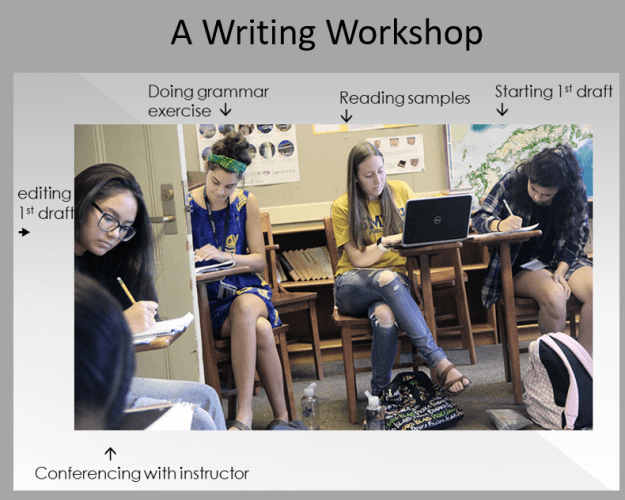
• The Writing Workshop: Countless Benefits for ESL Students and Teachers (REVISITED)

Cover workshop revisited Shot

This posting includes sample lessons of a Writing Workshop that give students a lot of autonomy.*

This posting is an update of my February 1, 2019 post:  Most Important Motivator of Students: How You Can Do It

Since posting this back in 2019, I’ve heard from teachers who decided to try out a Writing Workshop with their ESL Writing classes even though they were skeptical at first. Their hesitation seemed to be doubtful that their students would actually be productive without more direct teacher control. However, they reported that their initial skepticism was quickly dispelled after seeing the same great benefits that I had described in the post below. Almost all of them stated that they couldn’t imagine teaching a Writing class in any other way in the future.

Here is that posting.

Continue reading

• ESL Teachers’ Gift to Students: Silence

Cover Silence man

I’m experiencing life as a L2 learner for four hours. One of our colleagues, Susan, has volunteered to teach eight of us ESL teachers beginning Farsi for professional development. After we have learned some basics, she does an oral “drill”. She calls on me, and I feel some pressure to respond quickly not wanting to make everyone wait. To my relief, though, Susan patiently remains silent while I formulate my answer.

As she calls on others, I become aware of how I am feeling. To my surprise, unlike how I imagined my ESL students feeling in these situations, I , as an L2 learner, am not restlessly yearning for a faster pace. Instead, I appreciate the chance to formulate responses in my own mind, and when I’m called on again, I feel my stress level diminish.

 According to research, many of us ESL teachers find silence to be uncomfortable. And this can result in loss opportunities.

Continue reading