Category Archives: • During Class

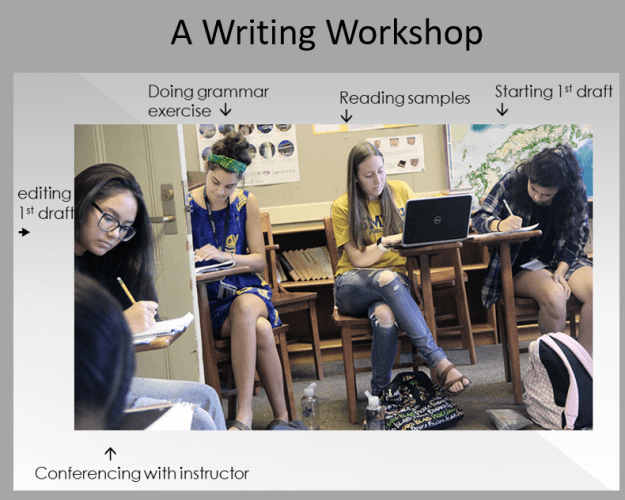
• The Writing Workshop: Countless Benefits for ESL Students and Teachers

Cover workshop revisited Shot

This posting includes sample lessons of a Writing Workshop that give students a lot of autonomy.*

This posting is an update of my February 1, 2019 post:  Most Important Motivator of Students: How You Can Do It

Since posting this back in 2019, I’ve heard from teachers who decided to try out a Writing Workshop with their ESL Writing classes even though they were skeptical at first. Their hesitation seemed to be doubtful that their students would actually be productive without more direct teacher control. However, they reported that their initial skepticism was quickly dispelled after seeing the same great benefits that I had described in the post below. Almost all of them stated that they couldn’t imagine teaching a Writing class in any other way in the future.

Here is that posting.

Continue reading

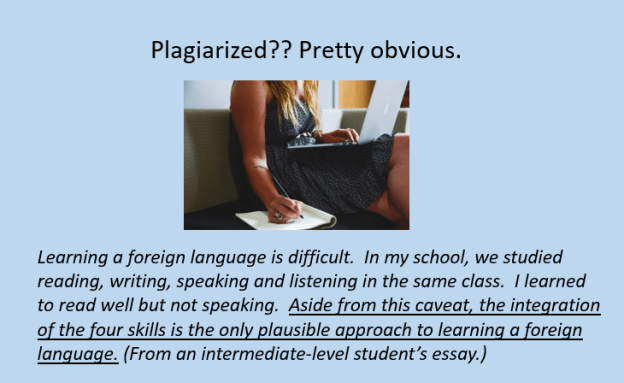
• Effective, Stress-Free Approach to Dealing with Plagiarism.

Cover plagiarized Revisit shot

This posting is an updated version of a post from November 2016: Writing Class: Dealing with Plagiarism (Don’t Take It Personally) 

In October 2016, Tiffany Martínez, a Latina student at Suffolk University in Boston, was accused of plagiarism by her sociology professor in front of the entire classHuffington Post plagiarism story   What caused him to be suspicious?  The word “hence.”  On her paper, he circled the place where she had written the word “hence” and wrote in the margin, “This is not your word.”

In my many years as an ESL instructor, I’ve witnessed instructors over-reacting in suspected plagiarism situations.  It seems as if those instructors were taking it personally, feeling like they were being disrespected.  Too often instructors seem to see it as a “gotcha” opportunity.

Plagiarism Learning Opportunities

Unless there is proof, the instructor shouldn’t accuse the student.  It would be more damaging to falsely accuse a students of plagiarizing who had worked hard than to “let” a students who actually plagiarized slip by.  If the student actually plagiarized, and the instructor has proof, it can be viewed as a learning opportunity.

Here are some options depending on the situation.

Continue reading

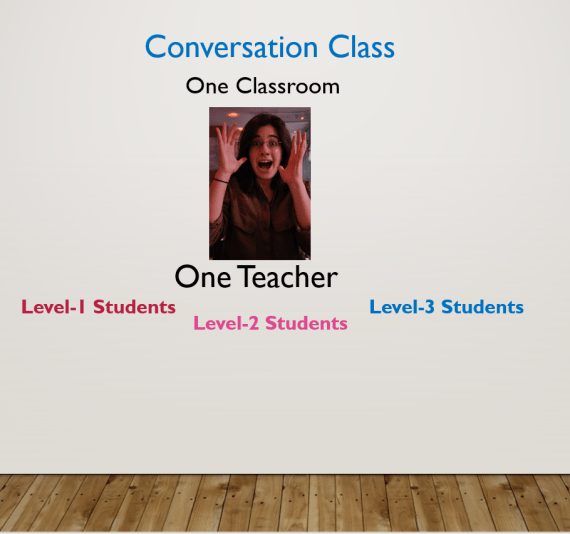
• Meeting A Conversation Course Challenge: Three Levels of Students, One Classroom, One Teacher

Cover multi level Shot

Having three levels of students in one classroom can be overwhelming. But for a reading-skills or writing-skills course, it seems relatively do-able because students can work individually on the reading or writing tasks.

However, for a conversation course in which students need to be interacting with classmates, it’s impossible right? No, it’s definitely possible.

Here is how it has been done successfully with a user-friendly approach for the teacher and with students developing their skills as they would in a single-level class.

Continue reading

• If You Want To Really Motivate Your ESL Students, This Will Do It.

Cover Motivation Purpose Shot

One problem for ESL teachers is that we can become complacent and start to take shortcuts. One day, part way through my career, I realized that this was happening to me.

I was teaching a TESL methods course to American university students who wanted to teach ESL. During one class, a student asked me what to do if some students aren’t doing the assignments or not doing them seriously. I told them that the most important motivator is to always introduce an assignment with an explanation of its purpose and how this assignment will help them in the short-  or long-term future.  WAIT! I suddenly realized that I had become lax in doing that in my own ESL classes.

For a dozen years, I had had the good fortune of teaching at colleges in Asia. For the most part, the students there were diligent about doing whatever I assigned without question. I soon fell in the habit of just tell them what the assignment was when I introduced it.

For example, in a Writing class, I might say, “We are going to do some practice with dramatic introductions. Look at pages 17-19. There are eight introductions. Two of them are dramatic. After you read each, you will identify which are dramatic.”

Or for a grammar exercise, I might say, “We are going to practice the most common places to use commas in sentence. Look at page 194. Let’s do the first exercise together.”

Or for a conversation activity, I would say, “Today, you will work with a partner and give directions to each other to find places on a map.”

Explaining the big picture purpose of an exercise: how it will help them in future.

Continue reading