Category Archives: *INDUCTIVE APPROACH & EXERCISES

• Taking On Phrasal Verbs

Cover phrasal verbs screen shot

*(This posting includes a handout which you are welcome to use with your students.)

YouTube This posting is discussed on my YouTube video Big Mistake ESL Teachers Make With Phrasal Verbs:

When Adrian came to class, he was wearing a tight t-shirt which accented his arm muscles. So I asked him, “Adrian, have you been working out?”

He just kind of looked at me, not knowing what to say. I realized that he didn’t understand the phrasal verb, “working out,” so I pantomimed lifting weights and asked him if he had been exercising. Then he got it.

According to The Grammar Book by Celce-Murcia and Larsen-Freeman, outside Germanic languages (English, German, Dutch and the Scandiavian languages), few languages have phrasal verbs. “Thus most ESL/EFL students will find such verbs strange and difficult. Yet they are such an important part of colloquial English that no one can … understand conversational English easily without a knowledge” of them.

About once a term at my college, we invited a guest speaker to give a talk to all the international students, from beginning-skill levels to advance. For example, a policeman talked about how to stay safe on and off campus; a counselor discussed common misunderstandings students have with plagiarism; a student leader provided information about campus clubs and activities.  Even though the speakers were making an effort to make their talks comprehensible to non-native speakers, they couldn’t help but continually peppered their speech with phrasal verbs. Some examples:

Policeman: If you drink and drive, you could end up at the police station.

Counselor: One reason students copy from a classmate is because they’ve taken on too many courses.

Student leader: We hope you’ll help us put forward some ideas for improving our clubs.

Imagine substituting these phrasal verbs with the phrase blah-blah.  This is kind of what many of the students heard:

     “… you could blah-blah at the police station”
     “…they’ve blah-blah too many courses.”
     “…help us blah-blah some ideas.”

No wonder so many of students had blank looks on their faces.

Working on phrasal verbs. Where to start, knowing that there are over 10,000 of them.

Continue reading

• The Grammar Aspect with Most Mistakes by Language Learners: Prepositions

*(This posting includes handouts which you are welcome to use with your students.)

I discuss this posting about prepositions in this short videoGrammar Aspect with Most Mistakes: Prepositions

According to Brain Briefs by Bob Duke and cognitive scientist Art Markman, “… adults who learn a new language make more mistakes with prepositions than with just about any other aspect of speech.”

Most ESL teachers have probably been asked questions like this one that I had from one of my students, Camila, from Mexico: “Why do we say ‘I’m confused about’ rather than ‘I’m confused at’?”

It seems futile to try to explain the reasons or give rules for when to use certain prepositions. And even if we could formulate some, it seems unimaginable that students will stop while speaking or writing and ask themselves, “Now what was the rule for the preposition here?” Just the preposition “on” has 10 definitions.

How to learn prepositions

Markman and Duke summarize what many professionals (e.g. Krashen) in the teaching ESL field  have said about how to learn prepositions: “… the best way … is to hear them, use them, and allow your brain to recognize which ones are appropriate in different circumstances by taking into account both the meaning and the statistics of when they are used.  This kind of implicit learning requires a lot of exposure to the language …” (p. 127).

This doesn’t mean that the only role that a teacher plays in this is to just provide meaningful input through reading and listening.

Three ways teachers can facilitate students’ learning of prepositions

Continue reading

• Tools for Describing Someone with Details: Inductive Writing Exercises (Low-Intermediate to Intermediate Level)


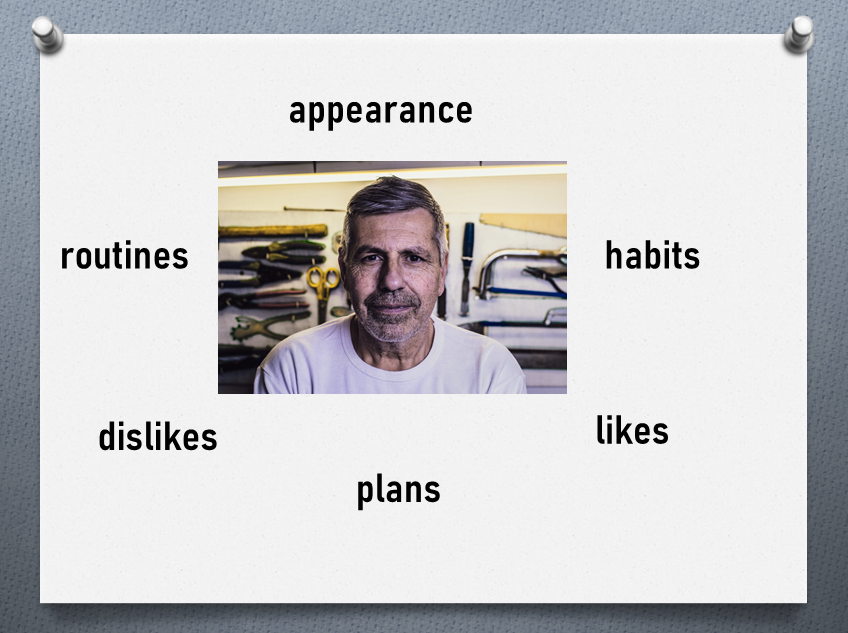
Describe someone Cover shot2

(This posting includes handouts which you are welcome to use with your students.)*

When written with enough details by students, a person description can be fascinating for teachers to read and can give them great insight into their students’ lives.

And, best of all, after they have learned some specific tools, students tend to have a lot of fun writing these.

Needless to say, when we talk about a person-description writing assignment, most people first think about physical appearance.  However, that is only one aspect of a person that students can include in their papers.  There are several other characteristics that they can describe, for example, habits, routines, plans, likes, and dislikes.

Teaching These Tools Inductively

Continue reading

• Most Important Motivator of Students: How You Can Use It

Workshop Cover shot

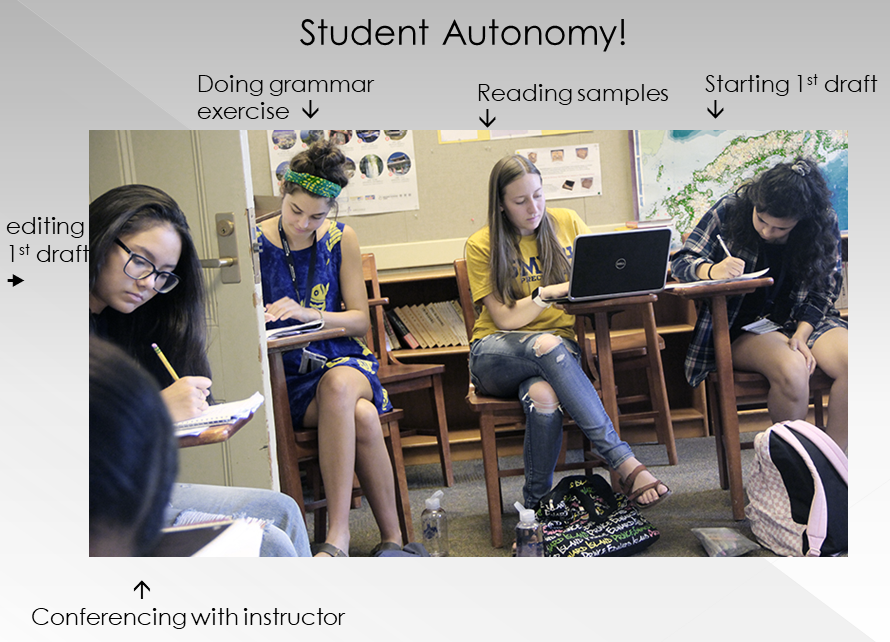
This posting includes sample lessons that give students a lot of autonomy.*

YouTube This posting is discussed on my YouTube video ESL Writing Workshop Approach

The most important ingredient for motivating students is autonomy. 1 The sense of being autonomous can produce a very positive effect on students’ attitude, focus and their performance.  Best of all, it’s very effective and quite easy to include this in ESL classes.

Having autonomy doesn’t mean that students decide what is taught in a lesson.  Instead, students can experience autonomy if the lesson is set up so that they can individually choose which exercise to do first, second etc., how fast to work, when to ask the teacher a question or for help and even when to take a break.

A lesson plan template that gives students autonomy (Writing Workshop)

Teachers can organize their lesson in a Writing Workshop using many different types of materials, but it works best when using inductive exercises.  That is because inductive exercises require little or no time taken up with teacher lectures.

These are General Steps for a Writing Workshop and Sample Specific Lesson with handouts

Continue reading