Category Archives: *ESL WRITING

These postings include writing activities, teaching techniques and strategies for evaluating writing skills.

• Most Important Process that You can do for Yourself, Your Students, Your Program (Part 1)

Cover Most important process

This process will give you, your colleagues, administrators, and most of all, your students great confidence in what you and your colleagues are teaching your students.  It will serve as a legitimate basis for the goals and outcomes of your courses.

This empowering process is called a needs analysis.  It is one of the most important things I have ever done as a professional, and I’ve done this everywhere I’ve taught.

And on top of all that, it can be stimulating and rewarding to do.

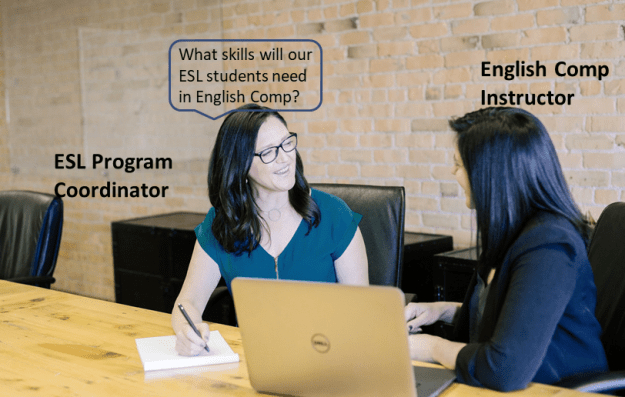
In brief, a needs analysis in an ESL context means finding out what skills students will need in order to be successful in the future.  The future can be the following term when they will be in the next level of a program; it can be when they finish their ESL instruction and will be in college courses (e..g. English Comp); it can be when they are traveling abroad; it can be when they enter the workforce.

These range from simple surveys of a small group of former students to more involved interviews with college instructors.

How to find out what skills students need to know once they leave our course or our program

Continue reading

• ESL Students’ Positive Responses to this Teacher Technique

success

          “I feel proud of myself when I see these.”

         “They are helpful because I feel that you are encouraging me and understand what I’m writing.”

These are two of the comments students wrote in response to my survey question: “On your essays, I underline in GREEN words, expressions, sentences, ideas, details and examples that were good.  Are these GREEN underlines helpful to you?”

Most Writing instructors like to give students positive feedback on their essays in addition to indications of where they have grammar mistakes or where they have content problems.  These positive comments often are in the form of a message at the end of the essay.  However, there are a few problems with giving feedback in this end-of-the-essay manner.

First, it takes time and extra mental energy to write these in a style that will be meaningful to students.

Second, they are usually too general to be of much use for students to apply to future writing assignments.

And third, it requires the teacher to write with clear handwriting, something that many of us don’t have a talent for.

In one program, on their essay rubrics, they now “include a section where students can earn points for successful language use rather than being strictly penalized for only misuses.”  This is admirable, but it (1) involves extra work and calculations for the teacher and (2) doesn’t specify exactly what the student did successfully in the essay.

The technique of using green underlines is very user-friendly time-wise and energy-wise for the teacher to use. 

Continue reading

• Innovative Approach to Writing: Introduce a new Unit with a Listening Activity


Cover shot

(This posting includes a handout which you are welcome to use with your students.)*

It can seem like our students have about a 20-second attention span.  So we try to squeeze in introductions to new Writing units during that period of time before they start thinking about text messages, their lunch, tonight’s date, last night’s date …

There is an effective and stimulating method for getting students to immediately interact with a new Writing unit through a listening activity.  We want them to feel engaged as they focus on the format and techniques that they will use when they eventually write an essay in this mode.  This approach does it in a user-friendly, enjoyable way.  Also, a side benefit is that students internalize some new sentence styles and new vocabulary.

First example of this approach

Continue reading

• Writing Class Person Description Activity: Fun, Lively and Productive

Cover secret classmate shot

(This posting includes a form which you are welcome to use with your students.) *

YouTube This posting is discussed on my YouTube video ESL Writing Class Activity: Fun, Lively and Productive

This is a paragraph that a student secretly wrote to describe one of her classmates.  All the students are circulating around the periphery of the room, reading description hanging on the wall with no names on and trying to determine who is being described in the paragraphs.  Each student seems very focused on reading the descriptions, searching for the classmate who is the object of the description but also looking out of the corner of their eyes to see what kind of reaction others are having to the description that they secretly wrote.  There is energy in the room, a lot of interacting and a lot of laughing.

Describe your classmate activity

In brief, the steps for this activity are:

Continue reading