Category Archives: • Grammar in the Writing Context

• I Stopped Trying to Catch AI Plagiarism. Here’s What I Do Instead.

Dealing with students who plagiarize now seems like a piece of cake compared to ones who now use AI to write their papers. I could usually deter students from plagiarizing by demonstrating how easy it is for teachers to find it.

Early in a term, I would show this paragraph that may have been written by a student:
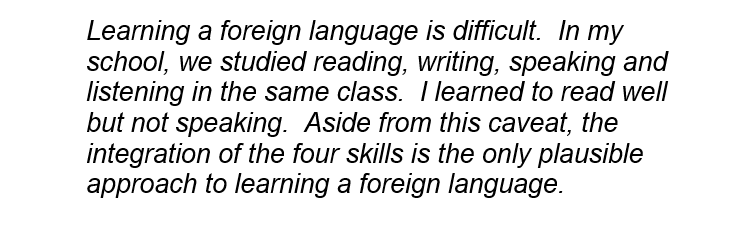
I’d ask them if they thought the writer had copied any of the sentences from a source. Unsurprisingly, they always spotted the last one. It was a clear signal: if a student can identify it, a teacher definitely can.

However, the rise of AI has shattered that approach.

Why the old technique doesn’t work anymore

Now, I can no long claim that it’s easy to find plagiarism using the sentence, “Aside from this caveat….” If a student plugged that into AI, it could come out as, “Even with this problem, I still think that learning the four skills together is the best way to study a foreign language.”

The vocabulary is simpler, the tone is conversational, and it is incredibly difficult to prove the student didn’t write it themselves.

According to reports from NPR and other outlets, many schools are spending thousands of dollars on AI-detection software. Yet, research shows these tools are far from reliable and frequently produce false positives. Few things are more discouraging for students than working hard on a paper and then being accused of not writing it themselves.
The “Incentive” Approach

Continue reading

• Inductive Grammar: Why are there commas in these sentences? Here are some clues. What’s the rule? (Revisit)

Cover comma blog shot

(This posting includes a handout which you are welcome to use with your students.) *

YouTube This posting is discussed on my YouTube video: Why is this comma here?
During a teacher-training course that I was teaching for American college students who wanted to teach ESL, we were discussing where to put commas.  Several of the students said that they decide according to their breath.  As they are re-reading something that they had written, if they stop to take a breath, that’s where they put a comma.  Wow!

Continue reading

• Myth #2 about Teaching ESL Grammar: Teaching Grammar Doesn’t Improve Students’ Writing. (REVISITED)

Cover Myths shot

I’ve always been perplexed by this claim by some teachers: “Teaching grammar doesn’t improve students’ writing.”  A problem with it is that it doesn’t define what is meant by “teaching grammar” nor what is meant by “improve students’ writing.”  It seems to imply that they have looked at every conceivable way that grammar could be taught and worked with, and they found that none were effective.

When I questioned their basis for this belief, I was often directed to some studies in the 1970s and 80s. Typically, these studies started with students writing a paper. Then for a period of time, they worked on diagramming sentences, doing sentence-combination exercises, identifying parts of speech and completing some grammar worksheets. After this, they wrote another paper, and surprise, surprise, the writing in their essays hadn’t improved. From this, they concluded: teaching grammar doesn’t improve students’ writing.

On top of that, one researcher claimed that his students’ writing got worse, and somehow, he even knew that it was because the students had become obsessed “with avoiding error at all costs, to the point where fluency, content, and reasoning lost their importance.” *

Some teachers have pointed to this “research” as support for their justification to not work with grammar in their writing courses. Their philosophy tends to be: students improve their writing by writing.

How Working with Grammar Can Improve Students Writing

Continue reading

• Semi-Colons Can Actually Be a Useful Tool for ESL Students

screenshot-1462

Hey, David. Did you notice the two semi-colons that I used in my essay?” Alvin asked me as he entered the classroom.

It’s easy to think that ESL students can live without semi-colons. However, after doing a brief lesson with them, I found that they not only can understand what they are, but also, how useful they can be.

As an introduction to semi-colons, I explain just three general points:

Continue reading