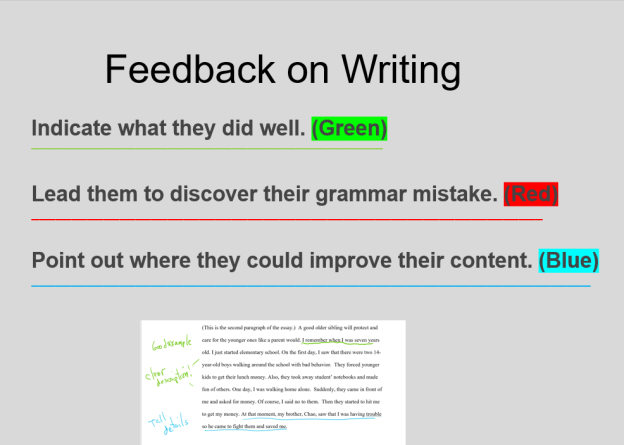
(This posting includes a handout which you are welcome to use with your students.)
This posting is a more detailed response to my interview question on Day 3 .LINCS Discussion: Student-Centered Approach to Teaching Writing Skills. .
Below in blue, you’ll find the details that I’ve added to the Day 3 LINCS’ posting.
Giving feedback to students on their writing is such a rewarding aspect of our job.
However, it’s important to do it in a way that is meaningful to students yet user-friendly for the teacher. Here is how we can do it.
Giving meaningful feedback in in a manner that is time and energy efficient
In general, we’d like to give three types of feedback on a piece of writing:
1) Indicate what they did well.
2) Lead them to discover their grammar mistakes.
3) Point out where they could improve their content.
1) Indicate what they did well.
Imagine that you are a student and just received your paper with this positive feedback from the instructor at the end of the essay:
This was a good essay. Your ideas were interesting. You used advanced sentence styles, and some of your examples helped me understand your main points.
Will these comments actually help you, as a student, apply how you wrote to future writing tasks? Which specific ideas were interesting? Which specific sentences was the teacher referring to as advanced and which examples were helpful?
A time-consuming alternative that some teachers turn to is to write the comments in the margin next to noteworthy places in the essay. The drawback to this, especially when commenting on paper, is that it is time consuming, there is little space to write them, and the handwriting needs to be clear. Also, one wonders whether students will actually read the comments.
Before describing an easy, efficient and effective method for giving focused positive feedback, it’s important to understand the reason why we want to give positive feedback. What we are trying to do is to encourage them to continue to use writing techniques which have made their writing assignments coherent, cohesive and interesting.
This means we’d like to point out, for example, where they have effectively used…


 Common Sense Teaching ESL