Dealing with students who plagiarize now seems like a piece of cake compared to ones who now use AI to write their papers. I could usually deter students from plagiarizing by demonstrating how easy it is for teachers to find it.
Early in a term, I would show this paragraph that may have been written by a student:
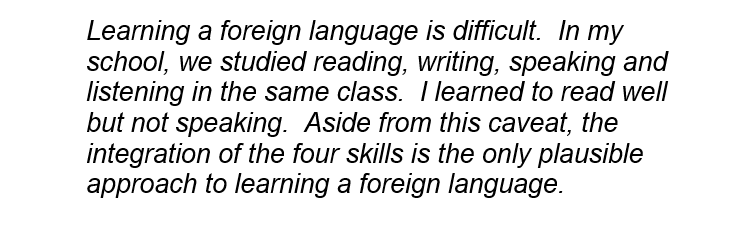
I’d ask them if they thought the writer had copied any of the sentences from a source. Unsurprisingly, they always spotted the last one. It was a clear signal: if a student can identify it, a teacher definitely can.
However, the rise of AI has shattered that approach.
Why the old technique doesn’t work anymore
Now, I can no long claim that it’s easy to find plagiarism using the sentence, “Aside from this caveat….” If a student plugged that into AI, it could come out as, “Even with this problem, I still think that learning the four skills together is the best way to study a foreign language.”
The vocabulary is simpler, the tone is conversational, and it is incredibly difficult to prove the student didn’t write it themselves.
According to reports from NPR and other outlets, many schools are spending thousands of dollars on AI-detection software. Yet, research shows these tools are far from reliable and frequently produce false positives. Few things are more discouraging for students than working hard on a paper and then being accused of not writing it themselves.



 Common Sense Teaching ESL