Category Archives: *ESL CONVERSATION & DISCUSSION TECHNIQUES

These postings include conversation activities, teaching techniques, strategies for groupings and evaluations.

• Most Important Tool for Managing Classroom Behavior (Case two and Caveat) REVISITED

Classroom management

“David, Please report to the Director’s office as soon as your class finishes.  He needs to talk to you.”  A program assistant handed me a note with those sentences on it.  Gulp!

In the early 1980s, my wife and I, without much thought, accepted teaching positions on the Greek island of Lesbos.  It was a Greek island, so what could possible go wrong?

It was a prep school that high school students attended in the late afternoons/evenings after high school to study English.  Shortly after arriving, we met one of the teachers whom we were replacing.  He told us that the school had a lot of discipline problems because many of the students didn’t want to be there.  He said that the teacher-turnover was quite high as a result.  In fact, a couple of teacher had just disappeared a few months earlier.

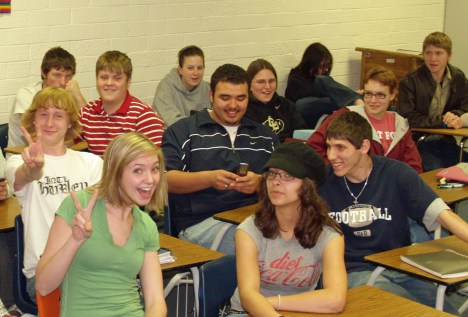
On the first day of class, as we walked down the hallway, we could see students literally chasing each other around the class rooms and jumping on the desks.  My first class was with 16 tenth-grade students.  Although most of the students paid little attention to me but instead continued to chat as I started the lesson, there were three female students sitting in the front row appearing eager to begin.  Those three became the focus of my attention.  Gradually, most of the others started to engage in the lesson, while a couple slept or doodled or looked out the window.

Continue reading

• Helping Our Students Who Feel Invisible (REVISITED)

triads

In the documentary, Becoming, about Michele Obama, Michele is asked about feeling invisible. Her description made me think more about how many of our ESL/International students probably feel invisible in classes, on campus and in society, and how we can help them.

My personal experiences with feeling invisible are quite trivial compared to what some of our students experience, but a recent episodes gave me a bit of a taste of how it feels.

I was talking to a colleague (we’ll say his name was Ben) outside the library when a young woman whom I didn’t know walked up to us with a smile on her face. The two of them obviously knew each other and started talking animatedly, without Ben introducing us. After a couple of minutes, they walked off together across campus.

That experience had little effect on me other than feeling a tad off balance or slightly irritated momentarily. But for International and minority students, being treated as invisible can be quite disheartening.

One young man described it this way, “The problem is that to many people, I am simply invisible. Nobody says ‘hello’ to me. Nobody nods to me. Nobody recognizes me as a person with something to say. Nobody listens to me. People make assumptions about me on the basis of my color and where I come from…But I am a person and have something to say — both as an individual and on the basis of my distinctive experience.”

In our classrooms, we can see the students who are probably feeling invisible. They are the ones who are not greeted by others who look past them and start talking to more familiar friends. Or the ones overlooked when their classmates are told to find a partner for an activity. Or the ones who sit silently seemingly unnoticed in group discussions.

How to help our ESL students feel visible.

Continue reading

• Another Conversation Activity: Listen to Partner and Ask Questions to Complete Information-Gap Chart (REVISITED)

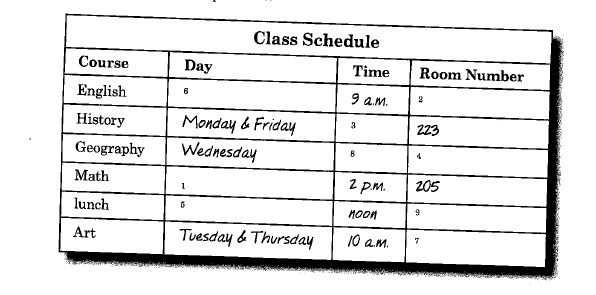
image schedule chart

(This posting includes a handout which you are welcome to use with your students.)*

At first, this pair-work activity looks like it’s about getting students to talk a lot by filling information in a chart.  But that’s not the most important value of it.

Yes, students will talk a lot during this.  But by including a short pre-exercise, they will see how they should ask clarification questions when they need more information or if they didn’t understand.  Asking clarification questions is the strategy that they can use in future conversation situations in and outside the classroom.

In this activity, the students will be filling in information about a class schedule.  They’ll need to listen to their partners tell them the name of courses, days, times and room numbers.  They’ll have many chances to ask questions, especially if they don’t understand.

There are three steps in this activity:

  • Step 1: Brief work with a model showing how to do Step 2.
  • Step 2: Pair activity (Student A/ Student B)
  • Step 3:  Exercise to do if they finish before other pairs have finished.

Continue reading

Entering a Lesson with Predictions (Part 2: Pre-Discussion Activities)

Cover pre speaking Pt 2 slide

(This article was originally published in MET (Modern English Teaching) in Spring 1986.)  MET website

In Part 1 ( • Entering a Lesson with Predictions (Part 1: Pre-Listening Activities) , I introduced how we can help student to focus on a particular day’s materials and to become personally involved in its content. We can do it through a “prediction process.” I also described two prediction activities as entries to listening activities.

In this Part 2, I’ll share two sets of “prediction activities” as entries to speaking/discussion activities. In the first one, the prediction activity is indirectly related to the speaking activity. In the second one, it is directly related to what they will be discussing in their groups.

Example of predictions as an indirectly-related “entry” to a speaking activity

Lesson plan:  The students were going to have group discussions about “fun.”

Prediction procedure (which preceded the discussion.) I found online a ranking of the 10 most fun countries in the world.

Step 1: A list of 10 countries in alphabetical order was given to each student. They then individually predicted the ranking of each one according to how fun the online survey found.  Next, they formed groups of three or four and shared their guesses (predictions) with the group members.

Step 2: The teacher read the rankings, as they had been listed in the online source. Students jotted the answers on their lists.

Step 3: Still in their groups, they compared how well they had predicted.

Step 4: The students then formed new groups of three or four. The students were given a list of discussion questions about “fun.” For example
1) Did you have fun last weekend
2) When you were a child, what did you do that was fun?
3) Do you think computers are fun?
4) Is there a country or city you want to go to for fun?
etc.

Observation: Even though the ranking of fun countries had no direct bearing on the discussion that followed, students appeared to automatically think broadly about the topic of fun.

Example of predictions as a directly- related “entry” to a speaking activity

Lesson plan: Students were going to discuss cheating. Before the discussion, they were first going to read an article about students cheating.

Prediction Procedure (which preceded the above plan)

Step 1: Before handing out the articles, a list of True-False questions concerning the information in the soon-to-be-distributed article was given to each student. For example:

According to the article …
1. 50% of college students said cheating was wrong.
2. 90% of college students said that they had cheated at some time.
3. Very young children cheat more than high school students.
4. Most parents think cheating is less serious than fighting.
etc.

Each student predicted what the article would say in response to questions such as these. Then in groups, they discussed the questions and their answers and arrived at a group decision regarding each. These were then put on the board

Step 2: Students were given copies of the article, which they then read silently.

Step 3:  Individual students summed up briefly for the class what the article had said in regard to each question. An acknowledgment went to that group which had most accurately predicted the article’s contents.

Step 4: In groups of three or four, students discussed cheating (using teacher-provided discussion questions) and shared their experiences.

In summary, the success of a language activity depends to a great extent on how involved students become in it. It has been our experience, and it is hoped that other ESL teachers will find the same, that by helping students to invest a part of them-selves at the “entry” into a lesson, such as was done with the “prediction procedure,” the chances for student engagment are enhanced.

This article was originally published in MET (Modern English Teaching) in Winter 1988-89.

David Kehe
Faculty Emeritus