Category Archives: *ESL CONVERSATION & DISCUSSION TECHNIQUES

These postings include conversation activities, teaching techniques, strategies for groupings and evaluations.

• The Eyes Have It: Keeping Students Focused During Group Work

Eyes image

I once had a colleague who was feeling distraught because her students didn’t seem to take group work seriously.  Her students tended to chat instead of doing the task and often finished early without completing it.  She asked me to observer her class to see if I could come up with any suggestions.

Within a few minutes of observing her class, I was reminded of a social psychology study that seemed related to her situation.  As you read the summary of the study below, you may wonder how this could be connected to ESL students working in groups.  Bear with me.

The study

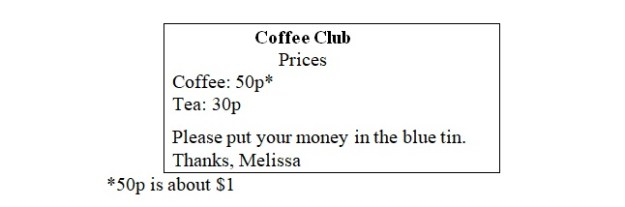
The Psychology Department at Newcastle University conducted this interesting study using their coffee station.  There was a sign above the coffee station:
Smaller coffee station screenshot

As you can see, it operates on an honor system.  For the 10-week study, researchers taped a picture of flowers for a week over the coffee station and then switched to a picture of a pair of staring eyes for a week.  They continued to alternate these pictures each week.

This is where it gets interesting

During the weeks that the poster of the eyes was staring, coffee and tea drinkers contributed almost three times as much money as in the weeks that the flower picture was on the wall.  What’s so amazing is that it was just a PICTURE of eyes, not an actual person, which seemed to make people more honest.

The researchers conducted a similar study to see if the flowers or eyes pictures could motivate people to clean up after their meals.  In that study, the number of people who cleaned up doubled when the eye picture was present compared to when the flower picture was.

How this social psychological study is connected to teaching ESL

Continue reading

• Stimulating Small-Group Discussion Activity 2: Loneliness Might Not Be What You Think (Including Paraphrasing Exercises.)

Cover read for discussion SHOT

(This posting includes a handout which you are welcome to use with your students.)*

Some reasons why students seemed stimulated by this discussion:

1) Since almost all the students were living away from home, they were able to relate to the challenge of connecting to new people.
2) They seemed interested in hearing how their classmates were coping with living away from home: some loved it and some felt lonely.
3) They enjoyed discussing how social media is both helpful and harmful especially concerning making connections to people.
4) They seemed surprised that some of their classmates are not especially connected to their family members.

Here is the basis for this discussion: According to research, loneliness has little connection to how many people are around us.  In his book,  Lost Connections,  Jonathan Hari explains that loneliness is caused by a loss of connection to others. To end loneliness, according Hari, we need two things: other people and a feeling that we are sharing something meaningful or something we care about with another person or other people.

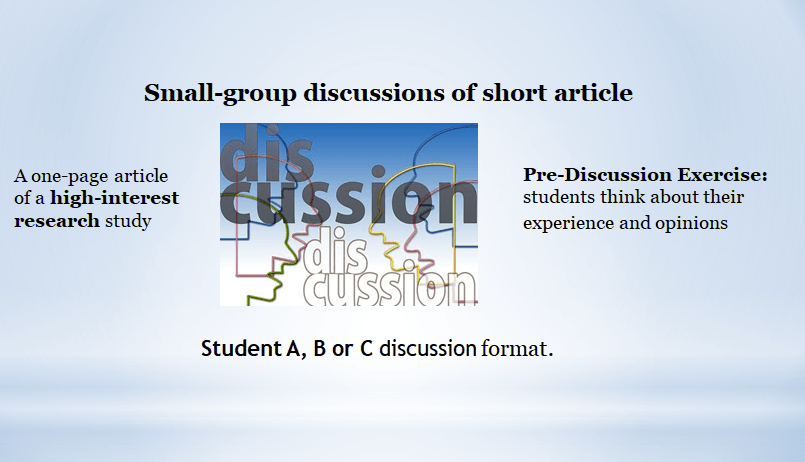
This and future discussion activities include four parts:

1) A one-page article usually including a brief summary of a high-interest research study.
2) Ten true-false comprehension questions.
3) Pre-Discussion Exercise in which students read and think about several questions about their experience and opinions about the topic before discussing them in groups.
4) Small-group discussions of the article in which each student is given a paper with different content/personal experience questions in the form of Student A, B or C.

Bonus for this Discussion Activity 2: Paraphrasing exercise.

About Discussion Activity 2: Loneliness Might Not Be What You Think and the handout.

Continue reading

• Conversation Activity: Getting Students to Say More Than the Minimum

Cover more than minimum Shot

(This posting includes a handout which you are welcome to use with your students.)*

 We might think that the students who say little in a conversation are lazy or just quiet by nature.  That’s not necessarily the case.  Some students have told us that they are trying to be polite and let others talk.  Others just don’t know what to say, so they say the minimum.  And some just aren’t aware that they should speak more.

This activity is designed to help these types of students. It “gives permission” to the polite students to talk more.  It “requires” the lazy or quiet ones to contribute to the conversation.  And it “pushes” everyone to think of something, anything, to say.

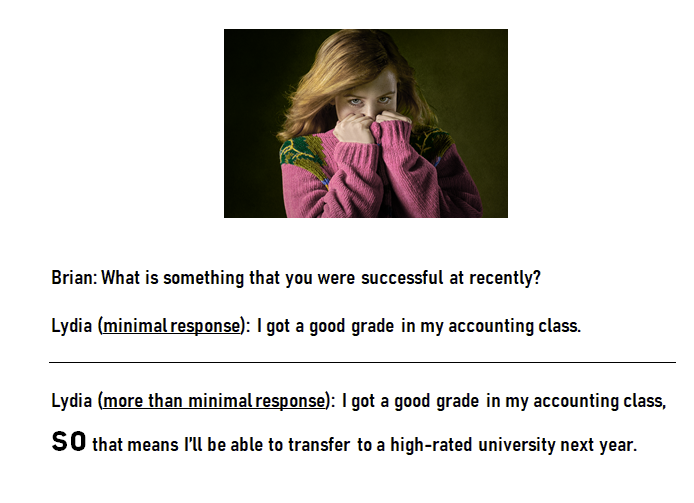
The activity is call Responding with Details. In groups of three, students ask each other the supplied questions (in a Student A, B, C format).  Every time the members respond, they have to answer with “and, but, so, because or with two sentences.

Example

  1. Marit: Where was the best place you ever lived?
  2. Lucien: I like warm weather, so I really loved living in California. (Answered with “so”.)
  3. Marit: When did you live there?
  4. Lucien: When I was in high school.  We moved there when I was 16 and stayed for three years. (Answered with two sentences and “and.”)

Steps in the activity (and the handout)

Continue reading

• Stimulating Small-Group Discussion Activity 1: Which Is More Effective– I’m Calm or I’m Excited?

(This posting includes a handout which you are welcome to use with your students.)*

Some reasons why students seemed stimulated by this discussion:

1) They were surprised that they were currently feeling different emotions on that day.
2) They seemed interested to hear about different ways they coped with stress.
3) They were surprised by the findings of the research in the article and how they could apply that to their future.
4) They enjoyed comparing experiences giving speeches or performing.

Here is the basis for this discussion: Researchers have found that when we are in a stressful situation, we will be better at handling it if we say to ourselves that we are excited rather than try to calm ourselves down.

This and future discussion activities include four parts:

1) A one-page article usually including a brief summary of a high-interest research study.
2) Ten true-false comprehension questions.
3) Pre-Discussion Exercise in which students read and think about several questions about their experience and opinions about the topic before discussing them in groups.
4) Small-group discussions of the article in which each student is given a paper with different content/personal experience questions in the form of Student A, B or C.
5) Optional writing reflection activity.

About Discussion Activity 1: Which Is More Effective–I’m Calm or I’m Excited? and the handout.

Continue reading