Category Archives: • Lower & Intermediate Levels

• Creating Positive Tension during Group Work

Cover tension in group work

 I’ve gained important perspectives from students over the years. The following insight was shared with me by a student after a group-work activity, and it altered how I organized groups.

Typically, during my first year of teaching ESL, when I wanted students to get with a partner or form groups of three or four, I instructed them to do that and let them choose whomever they wanted to work with. However, early in my second year, this happened.

Continue reading

• LINCS Discussion about Student-Centered Conversation Lessons.

Cover revised post discussion

Cover for Blog posting day 1

If you’d like to read the discussion about teaching conversation skills on LINCS, in which I was “interviewed” through posted Q & A for Dec. 6-9, here is the link: LINCS discussion about student-centered conversation lesson. 

David Kehe

• Starting and Ending a Conversation (Includes a Group Mixer Activity)

Cover Lrg start conv shot

(This posting includes a POWERPOINT presentation and HANDOUTS which you are welcome to use with your students.)*

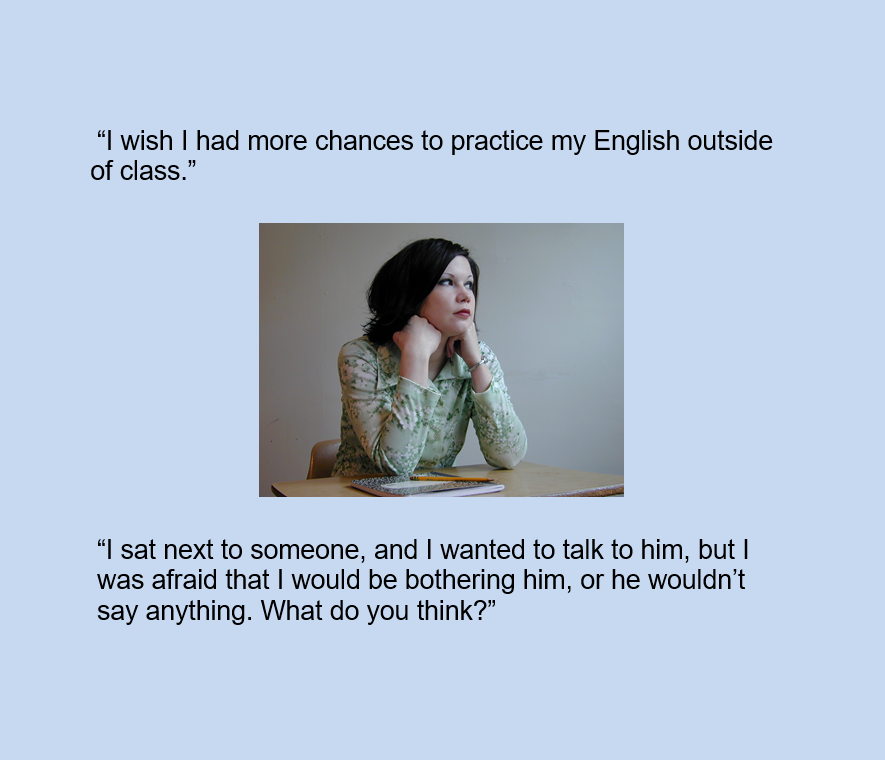
“I wish I had more chances to practice my English outside of class.”

“How can I meet some native-English speakers?”

“I went to a party last weekend. There were about 20 people there, but nobody seemed to want to talk to me. I just kind of stood in the corner looking at my cell phone. Why didn’t anyone talk to me?”

“I sat next to someone, and I wanted to talk to him, but I was afraid that I would be bothering him, or he wouldn’t say anything. What do you think?”

I’ve been asked these types of questions frequently by my students.  Naturally, some of them were low-level students with little confidence in their skills, but surprisingly, often more fluent ones also asked me for advice.

For students from some cultures, starting a conversation with someone they don’t know might be a new concept to them. (See Best Subject for an ESL Integrated-Skills Class (Part 2 of 4: Reading aspect) 

Exercises for starting-a-conversation skills Continue reading

 • A More Sophisticated Technique Than Just Saying, “What did you say?” and “I don’t understand.”

Clarif CS blah Cover SHOT

(This posting includes a handout which you are welcome to use with your students.)

Spoiler alert: You will hear quite a bit of laughing when students are doing the activity in pairs. 😁

Here is how I introduce this technique to intermediate-level ESL students:

If I say to you, “My cousin gave me a jigsaw puzzle,” and you say, “Pardon?” I’ll know you didn’t understand. But I won’t know which word you didn’t understand. It will help me if you let me know specifically which word you didn’t understand, so you might ask, “Your cousin gave you a what?” Then I know you didn’t understand “jigsaw puzzle.” Or you might ask, “Who gave you a puzzle?” Then I know you didn’t understand that I had said “my cousin.” This unit will give you practice in asking questions about specific information which you did not understand.

The practice for this technique involves a brief introductory exercise and a 3-step pair work activity.  (You can find the complete set of exercise to download and use with your students in the link below.)

Continue reading