

If you’d like to read the discussion about teaching conversation skills on LINCS, in which I was “interviewed” through posted Q & A for Dec. 6-9, here is the link: LINCS discussion about student-centered conversation lesson.
David Kehe
If you’d like to read the discussion about teaching conversation skills on LINCS, in which I was “interviewed” through posted Q & A for Dec. 6-9, here is the link: LINCS discussion about student-centered conversation lesson.
David Kehe

(This posting includes a handout which you are welcome to use with your students.)
1) They seemed interested in comparing the social rules in their countries and what happens to people who break them.
2) They had stimulating discussions how safe their hometowns were.
3) They were surprised by how tight or loose their classmates’ hometown and family rules were.
4) They enjoyed comparing how much or how little contact they had with people who were different from them (e.g. different race, religion, sexual orientation) and how open their neighbors would be to having them live next to them.
Here is the basis for this discussion: According to research, countries can be categorized as relatively tight or loose. Tight cultures, with stricter rules, tend to be safer more orderly, whereas, loose cultures tend to be more creative and more accepting of people who are different. After reading about the characteristics of different cultures, students compare their experiences and share their opinions about life in tight and loose cultures.
1) A one-page article usually including a brief summary of a high-interest research study.
2) Ten true-false comprehension questions.
3) Pre-Discussion Exercise in which students read and think about several questions about their experience and opinions about the topic before discussing them in groups.
4) Small-group discussions of the article in which each student is given a paper with different content/personal experience questions in the form of Student A, B or C.
 This posting is discussed on my YouTube video YouTube ESL Students Won’t Progress In Conversation Skills Without This Technique
(This posting includes a handout which you are welcome to use with your students.)
In her book, What Shamu Taught Me About Life, Love, and Marriage: Lessons for People from Animals and Their Trainers, Amy Sutherland describes how “progressive” animal trainers help animals who may feel nervous about anything new or that they are not accustomed to. One way is called desensitizing. She explains, “When you counter-condition, you take a negative experience and make it a positive one by pairing it with something good.”

She gives the example of a cavy, which is a South American rodent, who was terrified of the humans at the animal training school. Anytime that it needed vet care, it had to be caught, which meant chasing it around its cage, and this made it even more terrified of humans. The animal trainer set up a counter-conditioning. Each day she would enter the cavy’s cage and move just an inch closer. If the cagy didn’t hide behind a bush, the trainer would reward it with an alfalfa pellet. Overtime, the cavy allowed the trainer to come closer and closer, until one day the animal ate some pellets right out of the trainer’s hand.
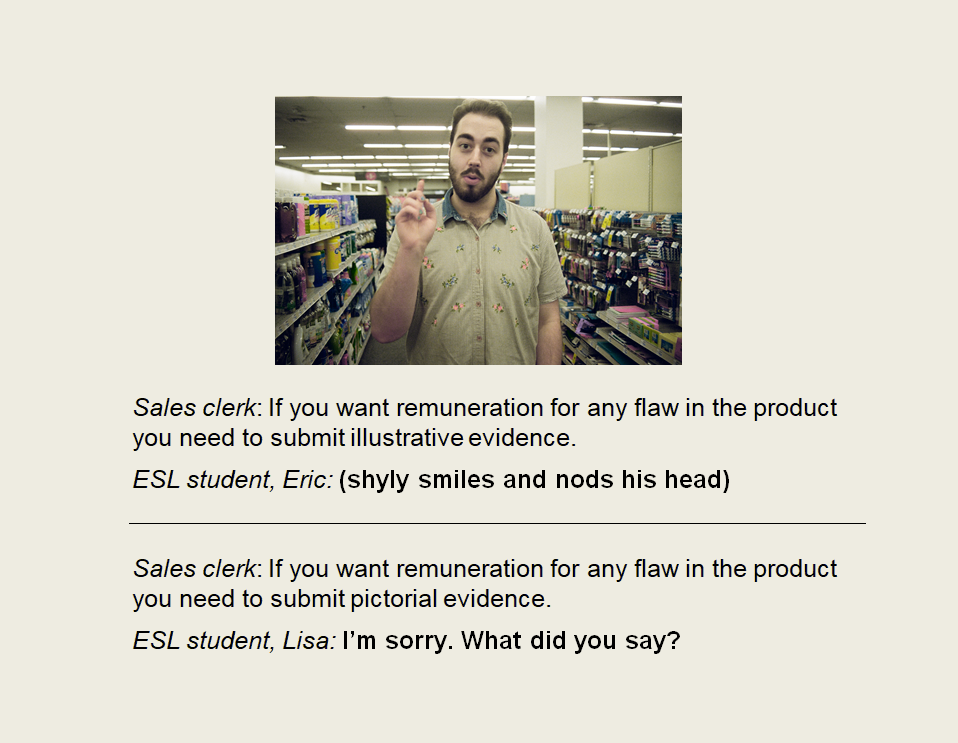
I realized that desensitizing our ESL students to a “negative experience” could help them become more open to using an important technique, just as it helped the cavy.
For many language learners, it seems so hard to say this or a similar phrase. For some, it can be embarrassing to appear less proficient than others (e.g. classmates) seem to be. Some don’t have confidence that they’ll understand even if their interlocutor repeats slower or rephrases what was said. Others don’t want to take up the other person’s time having to explain or simplify what they had just said.
I, myself even as an adult, was like this when I was trying to navigate my way around France or Japan. If the situation wasn’t dire, I usually just nodded like I understood and thanked them. But at times, when I really needed the information, I put aside my ego when I couldn’t understand and said in French or Japanese, “Excuse me. Could you repeat that?” To my amazement, nine out of ten times, the people adjusted their speech by speaking more slowly, and/or used easier vocabulary, pantomimed, and sometimes even used some English. Over time, I became desensitized to those negative emotions I had felt about saying, “I didn’t understand.”

A former ESL student of mine, Teddy, came to my office for a chat. I asked him how his classes were going, and he showed me the mid-term exam grade from his intermediate-level speaking class that his teacher had just given him. 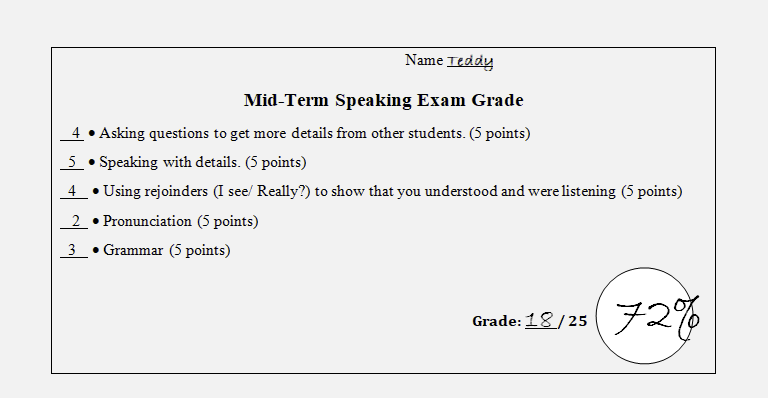 I asked him how he felt about it. He said that he was feeling discouraged because he really tries to be active in conversation, not only telling his ideas and opinions but also responding to and including other. So he felt that he deserved a much better score than a 72%, which was a failing grade.
Then I asked him, from looking at this grade form, what he thinks he’ll need to do to improve his grade.
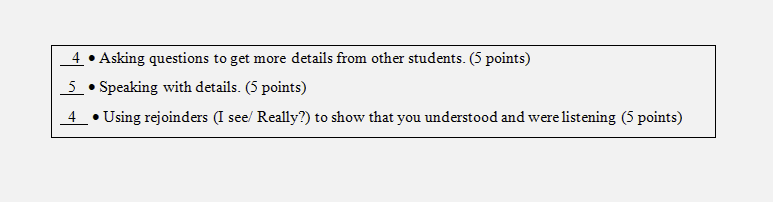
He felt confident that he could ask more questions and try to respond to others more with rejoinders.
But about the pronunciation and grammar grades, he said that he wasn’t sure.

He imagined that he might have some problems with “L” and “R” sounds. And he thought that the grammar score was low because he always makes mistakes with prepositions. So he planned to think more carefully about those when talking.

