Category Archives: *APPLIED PSYCHOLOGY IN TEACHING ESL

• Teachers: How To Sleep Well After a Class With a Couple of Troublesome Students

Why teachers’ brains tend to dwell on the  “disruptive” students rather than on the “attentive” students after class.  And what we can do about it.

Classroom management

I can have a class composed of 14 engaged students and two or three inattentive ones and guess whose faces I’ll see when I go to bed at night.  Right, the “slackers.”

I was interested to discover that I’m not the only teacher who has this happen to them.  This led me to try to understand the reason and investigate what to do about (in order to get a good night’s sleep.)

Why we tend to dwell on the troublesome ones and what to do about it.

Continue reading

• Simple Technique ESL Students can use to Impress Their Academic Instructors

Impress interesting Cover shot

(This posting includes a handout which you are welcome to use with your students.)*

Imagine that you are mainstream instructor (e.g. Psychology, English Comp, Economic), and as students enter the classroom, some stop to talk to you.

First, Josh approaches you and says, “That article you told us to read was so boring.”

Later, Ryan mentions to you,  “I found some interesting information in that article you told us to read.”

Of course you want your students to give their honest opinion, but it’s only natural that you’ll probably have a better impression of Ryan than Josh.  That positive impression could even have a favorable outcome for him when you are assigning grades.

This post is about a writing technique that our ESL students can use in their mainstream (academic) classes which can make a positive impression on their instructors.

Most instructors in any field think that their subject area is very interesting. For example, psychology, history, economics, English lit and engineering instructors often think that their subjects are the most interesting and important ones in the world. Needless to say, they love to hear their students say that they also think their classes are fascinating. Thus, our students can use this insight to stand out in the minds of their instructors.  And it could affect their grade in a positive way.

In addition, it involves good critical thinking.

Here is how it works and a handout activity to practice it.

Continue reading

• One of the Worst Mistakes Conversation Teachers Make

Cover worst mistake conv shot

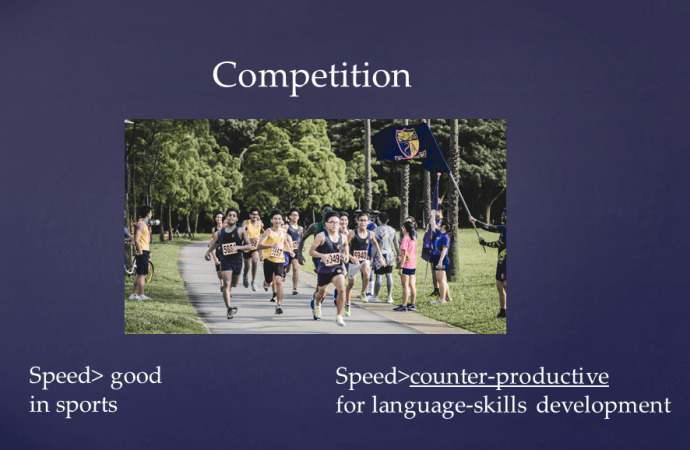
For some strange reason, some ESL instructors think they can improve any activity by making it as some kind of competition between students or between groups.  Unfortunately, doing this can be counterproductive and actually discourage the most serious students.

To illustrate, consider an information-gap activity like the one from a previous posting Another Conversation Activity: Listen to Partner and Ask Questions to Complete Information-Gap Chart  In this, pairs of students fill in missing information in a schedule by talking, asking questions, and using clarification strategies.

Imagine the teacher tells the students that he will give a prize to the pair who finishes the schedule first.  This is what will happen and how students will miss out on the skills that the activity is meant to develop.

Continue reading

• Common Teacher Myth: Students Don’t Like to See Red Marks on Their Papers.

This posting is discussed in this short video: Myth: Students Don’t Like to See Red Marks on Their Papers.

I conducted a survey of 48 students to find out how they felt about getting red marks, which indicated grammar mistakes, on their writing assignments.  I was motivated to do this after some colleagues had told me students get upset or dejected when they see these, so they only marked a few mistakes, and one even changed to a different color, thinking that, like her, students associated red marks with something negative.

Three types of marks on students papers

When I give students feedback on their writing assignments, I want them to notice three things:

  1. Good writing points.  These are ideas, details, examples, expressions, sentence styles, grammar that they did well.  I underline these in GREEN to indicate good.  (See Students’ Positive Responses to this Teacher Technique  for more details.)
  2. Weak grammar points.  These are grammar mistakes or wordings that they should revise to improve their papers.  I try to indicate these in a way that seem like a puzzle that can be stimulating for students to discover. I use RED to indicate these.  (See Most Effective Technique for Marking Grammar on Essays to Develop Self-Editing Skills  for more details.)
  3. Places to improve content.  These are places where students could improve their papers by adding details and/or including examples. I use BLUE to indicate these.    (See “Wow” is not Necessarily the Goal in Students’ Essays and The Huge Advantage International Student Writers Have Over Their American Classmates for more details.)

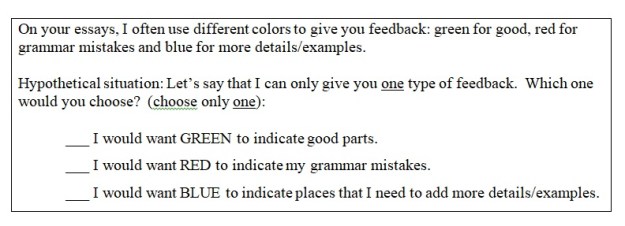
The survey question to students: If you could only have one type of mark on your papers, which one would you choose?

Color code survey

If those colleagues who thought students were upset by red marks (grammar mistakes) were right, then it would seem that the students would not choose that option, and in fact, probably prefer the Green (good parts) option.   Spoiler Alert: that didn’t happen.

Continue reading