
There seems to be certain times during a term when we can feel a bit overwhelmed by the amount of paperwork coming in. During those times, it makes sense to establish some priorities concerning how we approach “marking” the various assignments.
It’s sometimes tempting to rationalize not giving any feedback on or returning some homework assignments by thinking that there are intrinsic benefits for students to just do the exercises. We say to ourselves that it’s not absolutely vital that they get them back quickly (or even, in some cases, ever). Thus, we might consider doing a “triage” with assignments. Essays might get top priority for our time and attention with “lesser” assignments just filed away or held off until sometime in the future when we are all caught up.
Surprisingly, this feeling of being overwhelmed can actually open up a motivation to respond to homework assignments in a way that is more effective than how we would “normally” do it when we have plenty of time.
In his book, Drive, Daniel Pink noted, “The more feedback focuses on specifics and the more the praise is about effort and strategy rather than about achieving a particular outcome, the more effective it can be.”
Applying this to our ESL classes, when our time is limited, we can focus on the most important aspect of a homework assignment. And this can actually have a better outcome than “marking everything” as we might feel we are “supposed” to do when we have more time.
Let’s say you want to encourage your students to use examples in their papers. Thus, you assigned an exercise in which they are given a set of topic sentences and are instructed to add an example for each. For example,

After students turn in the assignment, normally, when you are not overwhelmed with paper work, you might not only look to see if they used an introductory phrase “For example” or “For instance,” but you also might also mark the grammar in each item and perhaps even the spelling and vocabulary. You might give some recommendations if you felt the example was too short.
However, as Pink explained above, it would be more effective to just focus on their effort to give an example. We can easily and quickly do that by highlighting in green.
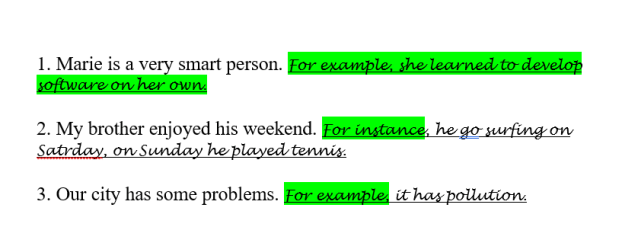
Notice, that we don’t need to spend time on the grammar and spelling mistakes in #2 because the focus is on the effort of giving examples. At the same time, by only highlighting in green the phrase “For instance,” we don’t have to worry that we are reinforcing those mistakes. Mistakes like those can be the focus on a verb-form exercise in the future.
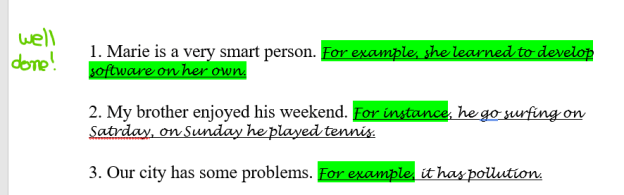
To give special recognition and motivation, we can add a short note next to a specific item or two.
A final strategy for approaching paperwork concerns assigning grades or points. In a previous posting, • Don’t Give Points. Give Green Instead. Save Time from Counting and Recording Points. , I discuss another way that we can approach homework (especially when we are feeling overwhelmed). In it, I try to address two related concerns that teachers wonder about if they don’t give points on assignments:
- What happens if a student doesn’t do an assignment if you don’t give points?
- How do you decide students’ final grade for the course if you don’t give points on assignments and don’t record them?
In sum, by thinking outside the “This-is-what-teachers-are-supposed-to-do” box, we can not only save our time and mental energy, but also help our students more effectively.
For a related posting, see • ESL Students’ Positive Responses to this Teacher Technique
David Kehe
Faculty Emeritus
 Common Sense Teaching ESL