Tag Archives: small-group activity

• LINCS Topic 4: What are some ways that we can include interactive activities in ESOL Writing class?  

Cover 4 interactive REV

 (This posting includes a links handouts which you are welcome to use with your students.) 

This posting is a more detailed response to my interview question on Day 4 LINCS Discussion: Student-Centered Approach to Teaching Writing Skills. .

Below in blue, you’ll find the details that I’ve added to the Day 4 LINCS’ posting.

I have some interactive activities that I include during each writing unit.

They do give variety to a writing class, but more importantly, they are effective in helping students develop their writing and editing skills.

1) Writer-in-control peer editing. Type 1: Writers prepare questions.

In traditional peer-editing activities, the students read a classmate’s essay and give feedback by filling out a teacher-provided questionnaire, rubric or checklist. (For example, “Is the topic sentence clear?” “Are the verb tenses correct?”)

For this non-traditional approach below, the writers have control over the type of feedback they want. Here are the steps:

Step 1: (A model) Sample essay and peer editing questions. In order to demonstrate to students how they will peer-edit with a classmate and the type of questions that they can ask, they work with a model essay with peer editing questions that the “writer” has asked.
(See link to a model exercise below.) After working with a sample, they then apply this technique to their own essays, starting with the Preparation Step.

Step 2: Preparing for Peer Editor. After students have written their essays, they identify specific parts of it in which they’d like a peer’s advice.  These could be about the grammar in some sentences, clarification of an example, a need to add details etc. On a separate piece of paper, they write questions about these parts that they will ask a peer-editor. For example, “Look where I wrote #1. Is my example clear?” “Look where I have #4. Is there a problem with this sentence?” “Look at #8. How can I improve my conclusion?”
Continue reading →

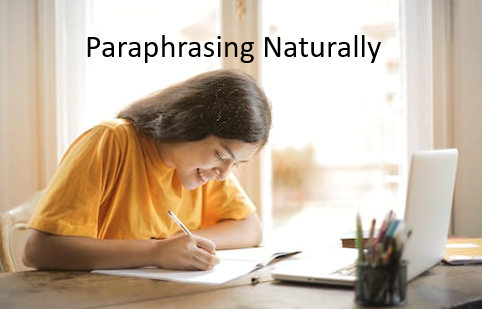
• Developing Paraphrasing Skills: Oral Paraphrasing Before Written.

Cover paraphrasing shot

(This posting includes a handout which you are welcome to use with your students.) *

YouTube I discuss this posting in this video: Developing ESL Paraphrasing Skills Naturally: Start with Oral Paraphrasing Exercise
A good paraphrase can demonstrate to the teacher that the student truly understood the source. And if it is clearly written in the student’s normal style and level of vocabulary, the teachers can feel reassured that the writer wasn’t plagiarizing.

Paraphrasing may be a new concept for many of our ESL student. However, we can help them understand how to do it in a way that will let them “experience” what a good paraphrase is through a very natural process.

Continue reading →

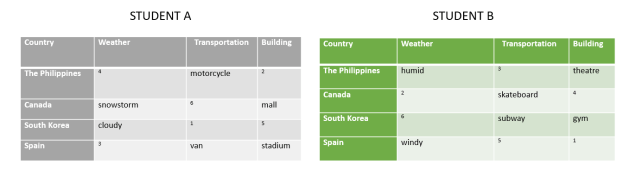
• Getting The Most Out of Information-Gap Chart Activities PART 2 (Vocabulary Reinforcement)

Cover info gap 2 shot

(This posting includes a handout which you are welcome to use with your students.)

You can see my video discussing Part 1 & Part 2 here: VIDEO Getting The Most Out of ESL Information-Gap Activities: Six Recommendations

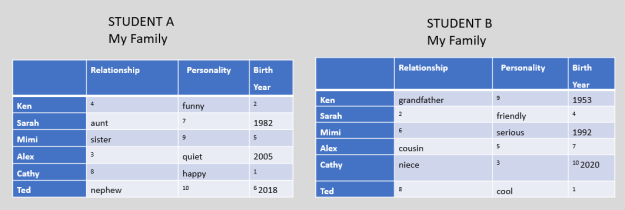
I have found these information-gap chart pair-activities to be a great go-to interactive activity when I’d like to review and reinforce vocabulary words and conversation strategies. And best of all, they are quite easy to make and customize.

In my previous posting, PART 1, I shared a chart in which the categories were:

Relationship         Personality         Birth Year

Cover Info Part 1 shot

See • Getting The Most Out of Information-Gap Chart Activities PART 1

I had made that one because I wanted to review vocabulary for relationships like cousin, nephew, niece, and aunt, and for personalities like serious, cool, and funny.  Later in the course after students had developed more vocabulary, I revised the chart to so that they could review:

Slide 1 less familiar

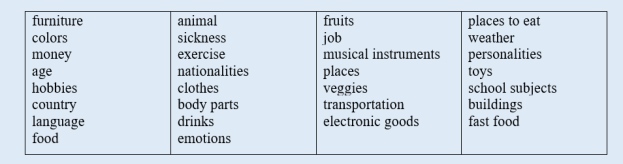
I’ve also made charts that included some of these categories:

Slide 2 categories

Here are two sites that have been helpful for the vocabulary in these categories:

Continue reading →

• Creating Positive Tension during Group Work

Cover tension in group work

 I’ve gained important perspectives from students over the years. The following insight was shared with me by a student after a group-work activity, and it altered how I organized groups.

Typically, during my first year of teaching ESL, when I wanted students to get with a partner or form groups of three or four, I instructed them to do that and let them choose whomever they wanted to work with. However, early in my second year, this happened.

Continue reading →