• Integrated vs Discrete Skills ESL Courses: Advantages of Discrete Skills

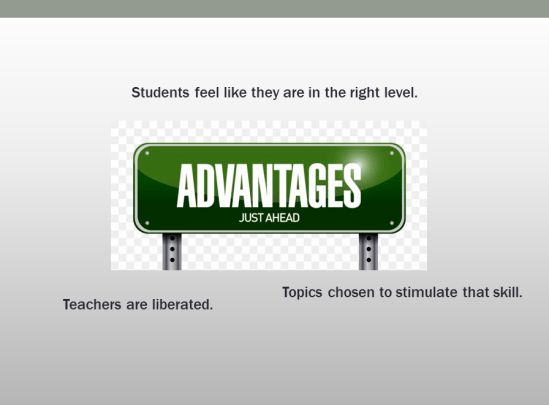
Cover Advantage Descrete shot

For an extended discussion of this topic with links to some YouTube videos and downloadable exercises, see Four Part Series: Why, How And When to Teach ESL Integrated- and Discrete-Skills Courses. 

YouTube This posting is discussed on my YouTube video: YouTube about advantages of discrete-skills courses

After the first day at a college I had previously taught at, I noticed a long line of students outside our EAP (English for Academic Purposes) director’s office.  It was my first day teaching in this program, so, needless to say, I was curious.  It turns out these students all felt that they had not been placed in the right level.

I soon discovered that this was a common occurrence on the first day of each term in that program.

The courses in that EAP program were organized around integrated skills, so each student was placed into one of five levels for all five hours of instruction. 1 By the end of the first day, students were quick to notice that some of their classmates were weaker than they were in some skills (e.g. speaking) but higher in others (e.g. reading).  They also were aware that some of the activities during the course of the day, depending on the skill, were right at their level, but others were above or below.

It’s not too surprising that this would happen.  New students had been given a placement exam that tested multiple skills: reading, writing, speaking, listening and grammar.  The exam resulted in one score, and their level was determined by that one score.  That seemed to be the crux of the problem. 

Continue reading

• Conversation magic: Two most important conversation techniques (Part 1)

Cover Rejoinders SHOT

(This posting includes a handout which you are welcome to use with your students.)*

YouTube This posting is discussed on my YouTube video The Two Most Important Conversation Techniques to Teach ESL Students (Part 1)

Making conversation magic happen

After a colleague used these exercises with her students, she told me with wonder in her eyes, “I saw magic happen in my class today.  My students suddenly became very animated, their voiced rose, and they were laughing!” 

Then she wondered if it was some kind of set up.  In other words, by using these techniques, students have no choice but to feel like someone is interested in what they are saying.

In a sense, she is right.  But isn’t that what we hope our students will experience? These are the two techniques:

1) Use rejoinders to show that they understand what the other has said by giving understanding responses.

2) Ask follow-up questions to maintain the conversation and to show interest in each other..

When someone uses these in a conversation, their interlocutor can’t help but feel like someone thinks they are interesting to talk to.

Use rejoinders and make your interlocutor feel good.

Continue reading

• Conversation magic: Two most important techniques. (Part 2)

Follow up Cover shot

This posting includes a handout which you are welcome to use with your students.) *

YouTube This posting is discussed on my YouTube video The Two Most Important Conversation Techniques to Teach ESL Students (Part 2)

The conversation magic: Making others feel like they are interesting people by asking follow-up questions.

Combined with rejoinders (explained in Part 1), this technique is almost guaranteed to engage students in animated and enjoyable conversations.

The second activity involves maintaining and extending the conversation by questions about what their partner has said.  It’s called “Using Follow-Up Questions.”  See Part 1 about Rejoinders  Conversation magic: Two most important conversation techniques (Part 1)

Continue reading

• How to lead ESL Students to Discover their Grammar Mistakes on Writing Assignments

tutoring-writing

One-on-one conferencing

Example of telling, not leading a students: “I see that you have a mistake in this sentence in your essay.  Instead of writing, ‘He was gave a reward,’ you should write, ‘He was given a reward.'”

All over the world and on almost every campus, there is a need for well-qualified teachers/tutors who understand grammar terms and who can “lead” ESL students to discover and correct their own mistakes, and by so doing, become better at self-editing.  Unfortunately, many teachers/tutors merely tell students what their mistakes are and how to correct them.  This approach has been proven to be ineffective at making students aware of their mistakes and at helping them become independent. The purpose of this posting is to give a brief introduction to an innovative and at the same time straight-forward techniques which teachers/tutors can use when conferencing individually with students about their writing assignments.

Continue reading