Category Archives: 06 ❖ ESL WRITING

These postings include writing activities, teaching techniques and strategies for evaluating writing skills.

• The Grammar Aspect with Most Mistakes by Language Learners: Prepositions (REVISITED)

*(This posting includes handouts which you are welcome to use with your students.)

I discuss this posting about prepositions in this short video: Grammar Aspect with Most Mistakes: Prepositions

According to Brain Briefs by Bob Duke and cognitive scientist Art Markman, “… adults who learn a new language make more mistakes with prepositions than with just about any other aspect of speech.”

Most ESL teachers have probably been asked questions like this one that I had from one of my students, Camila, from Mexico: “Why do we say ‘I’m confused about’ rather than ‘I’m confused at’?”

It seems futile to try to explain the reasons or give rules for when to use certain prepositions. And even if we could formulate some, it seems unimaginable that students will stop while speaking or writing and ask themselves, “Now what was the rule for the preposition here?” Just the preposition “on” has 10 definitions.

How to learn prepositions

Markman and Duke summarize what many professionals (e.g. Krashen) in the teaching ESL field  have said about how to learn prepositions: “… the best way … is to hear them, use them, and allow your brain to recognize which ones are appropriate in different circumstances by taking into account both the meaning and the statistics of when they are used.  This kind of implicit learning requires a lot of exposure to the language …” (p. 127).

This doesn’t mean that the only role that a teacher plays in this is to just provide meaningful input through reading and listening.

Three ways teachers can facilitate students’ learning of prepositions

Continue reading →

• Semi-Colons Can Actually Be a Useful Tool for ESL Students

screenshot-1462

“Hey, David. Did you notice the two semi-colons that I used in my essay?” Alvin asked me as he entered the classroom.

It’s easy to think that ESL students can live without semi-colons. However, after doing a brief lesson with them, I found that they not only can understand what they are, but also, how useful they can be.

As an introduction to semi-colons, I explain just three general points:

Continue reading →

• The Writing Workshop: Countless Benefits for ESL Students and Teachers (REVISITED)

Cover workshop revisited Shot

This posting includes sample lessons of a Writing Workshop that give students a lot of autonomy.*

This posting is an update of my February 1, 2019 post:  Most Important Motivator of Students: How You Can Do It

Since posting this back in 2019, I’ve heard from teachers who decided to try out a Writing Workshop with their ESL Writing classes even though they were skeptical at first. Their hesitation seemed to be doubtful that their students would actually be productive without more direct teacher control. However, they reported that their initial skepticism was quickly dispelled after seeing the same great benefits that I had described in the post below. Almost all of them stated that they couldn’t imagine teaching a Writing class in any other way in the future.

Here is that posting.

Continue reading →

• Fluency Writing: Reading, Speaking In Triads, And Listening Culminating In A Writing Task (REVISITED)

Cover fluency shot

                                          Integrating the four skills

(This posting includes a handout which you are welcome to use with your students.)*

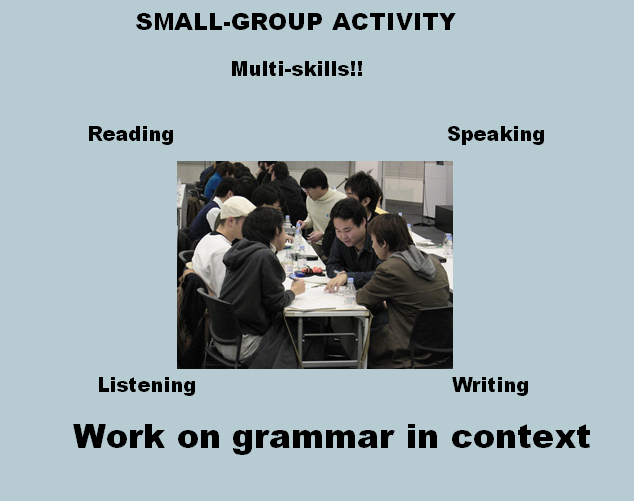
This is the perfect activity for integrating four skills into one activity.  And it culminates in a writing task in which students focus on controlling their grammar and on their sentence style.  It’s also one in which students can practice those two aspects of writing without having to spend time thinking about what to write.

These fluency activities can be used throughout a term when instructors would like to have students work on their grammar in a writing context and/or when they would like to add some group work in their writing classes.  Also, it’s a good lead-in to teaching paraphrasing skills.

Continue reading →