Category Archives: 06 ❖ ESL WRITING

These postings include writing activities, teaching techniques and strategies for evaluating writing skills.

• Tools for Describing Someone with Details: Inductive Writing Exercises (Low-Intermediate to Intermediate Level)


Describe someone Cover shot2

(This posting includes handouts which you are welcome to use with your students.)*

When written with enough details by students, a person description can be fascinating for teachers to read and can give them great insight into their students’ lives.

And, best of all, after they have learned some specific tools, students tend to have a lot of fun writing these.

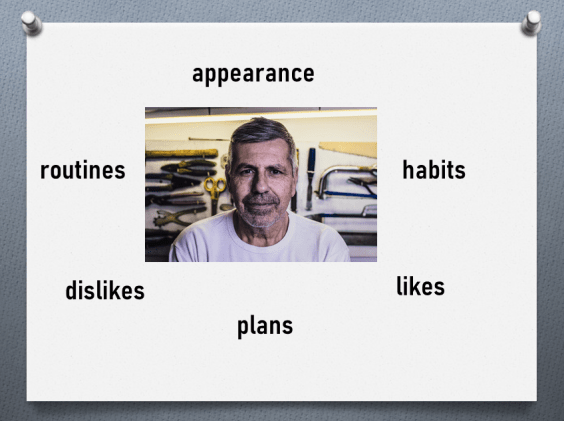
Needless to say, when we talk about a person-description writing assignment, most people first think about physical appearance.  However, that is only one aspect of a person that students can include in their papers.  There are several other characteristics that they can describe, for example, habits, routines, plans, likes, and dislikes.

Teaching These Tools Inductively

Continue reading

• Common Teacher Myth: Students Don’t Like to See Red Marks on Their Papers.

This posting is discussed in this short video: Myth: Students Don’t Like to See Red Marks on Their Papers.

I conducted a survey of 48 students to find out how they felt about getting red marks, which indicated grammar mistakes, on their writing assignments.  I was motivated to do this after some colleagues had told me students get upset or dejected when they see these, so they only marked a few mistakes, and one even changed to a different color, thinking that, like her, students associated red marks with something negative.

Three types of marks on students papers

When I give students feedback on their writing assignments, I want them to notice three things:

  1. Good writing points.  These are ideas, details, examples, expressions, sentence styles, grammar that they did well.  I underline these in GREEN to indicate good.  (See Students’ Positive Responses to this Teacher Technique  for more details.)
  2. Weak grammar points.  These are grammar mistakes or wordings that they should revise to improve their papers.  I try to indicate these in a way that seem like a puzzle that can be stimulating for students to discover. I use RED to indicate these.  (See Most Effective Technique for Marking Grammar on Essays to Develop Self-Editing Skills  for more details.)
  3. Places to improve content.  These are places where students could improve their papers by adding details and/or including examples. I use BLUE to indicate these.    (See “Wow” is not Necessarily the Goal in Students’ Essays and The Huge Advantage International Student Writers Have Over Their American Classmates for more details.)

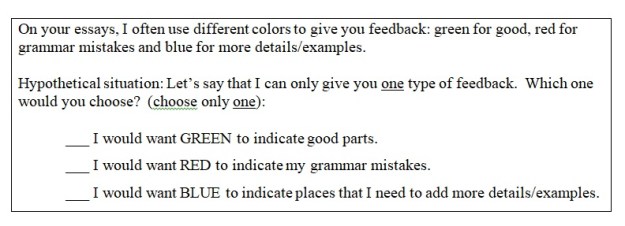
The survey question to students: If you could only have one type of mark on your papers, which one would you choose?

Color code survey

If those colleagues who thought students were upset by red marks (grammar mistakes) were right, then it would seem that the students would not choose that option, and in fact, probably prefer the Green (good parts) option.   Spoiler Alert: that didn’t happen.

Continue reading

• Most Important Motivator of Students: How You Can Use It

Workshop Cover shot

This posting includes sample lessons that give students a lot of autonomy.*

YouTube This posting is discussed on my YouTube video ESL Writing Workshop Approach

The most important ingredient for motivating students is autonomy. 1 The sense of being autonomous can produce a very positive effect on students’ attitude, focus and their performance.  Best of all, it’s very effective and quite easy to include this in ESL classes.

Having autonomy doesn’t mean that students decide what is taught in a lesson.  Instead, students can experience autonomy if the lesson is set up so that they can individually choose which exercise to do first, second etc., how fast to work, when to ask the teacher a question or for help and even when to take a break.

A lesson plan template that gives students autonomy (Writing Workshop)

Teachers can organize their lesson in a Writing Workshop using many different types of materials, but it works best when using inductive exercises.  That is because inductive exercises require little or no time taken up with teacher lectures.

These are General Steps for a Writing Workshop and Sample Specific Lesson with handouts

Continue reading

• The Huge Advantage International Student Writers Have Over Their American Classmates

COVER REV shot

(This posting includes a handout which you are welcome to use with your students.)*

YouTube This posting is discussed on my YouTube video  Huge Advantage International Student Writers Have Over Their American Classmates—A Writing Technique

It can be liberating to ESL students to realize that almost anything that they can include in their essays/papers about their culture and country will probably be interesting to their American instructors.  This is a great advantage that they have over their American classmates.

However, just encouraging them to include this kind of information in their essays often results in paragraphs like this one from an essay about raising children:

In addition to teaching skills, parents sometimes need to discipline a child who misbehaves. Some people will spank their children in order to get their attention and redirect them.  However, in my country, parents very rarely do this.

The writer did include information from his country, but he missed an opportunity to exploit this information and make it more remarkable.  After being asked for more details, the writer revised the end of the paragraph:

… However, in my country, parents very rarely do this.  Instead, if a child refuses to listen to his mother or throws a tantrum, his mother will tell him to stand outside the house. The worse thing that can happen to someone in my culture is to be excluded from the group, so this type of punishment can be very effective.

An Inductive Approach to Teaching this Technique (and handout exercises)

Continue reading