Category Archives: • Lower & Intermediate Levels

 • A More Sophisticated Technique Than Just Saying, “What did you say?” and “I don’t understand.”

Clarif CS blah Cover SHOT

(This posting includes a handout which you are welcome to use with your students.)

Spoiler alert: You will hear quite a bit of laughing when students are doing the activity in pairs. 😁

Here is how I introduce this technique to intermediate-level ESL students:

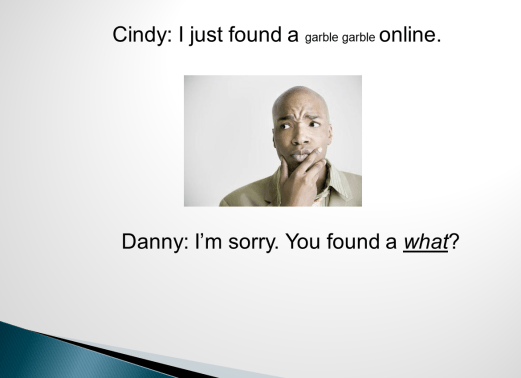
If I say to you, “My cousin gave me a jigsaw puzzle,” and you say, “Pardon?” I’ll know you didn’t understand. But I won’t know which word you didn’t understand. It will help me if you let me know specifically which word you didn’t understand, so you might ask, “Your cousin gave you a what?” Then I know you didn’t understand “jigsaw puzzle.” Or you might ask, “Who gave you a puzzle?” Then I know you didn’t understand that I had said “my cousin.” This unit will give you practice in asking questions about specific information which you did not understand.

The practice for this technique involves a brief introductory exercise and a 3-step pair work activity.  (You can find the complete set of exercise to download and use with your students in the link below.)

Continue reading →

• ESL Students Won’t Progress In Conversation Skills Without This Technique.

Cover blah pt 1 shot

YouTube This posting is discussed on my YouTube video YouTube ESL Students Won’t Progress In Conversation Skills Without This Technique

(This posting includes a handout which you are welcome to use with your students.)

In her book, What Shamu Taught Me About Life, Love, and Marriage: Lessons for People from Animals and Their Trainers,  Amy Sutherland describes how “progressive” animal trainers help animals who may feel nervous about anything new or that they are not accustomed to. One way is called desensitizing. She explains, “When you counter-condition, you take a negative experience and make it a positive one by pairing it with something good.”

cavy shot

She gives the example of a cavy, which is a South American rodent, who was terrified of the humans at the animal training school. Anytime that it needed vet care, it had to be caught, which meant chasing it around its cage, and this made it even more terrified of humans. The animal trainer set up a counter-conditioning. Each day she would enter the cavy’s cage and move just an inch closer. If the cagy didn’t hide behind a bush, the trainer would reward it with an alfalfa pellet. Overtime, the cavy allowed the trainer to come closer and closer, until one day the animal ate some pellets right out of the trainer’s hand.

I realized that desensitizing our ESL students to a “negative experience” could help them become more open to using an important technique, just as it helped the cavy.

“I’m sorry. I didn’t understand that.”

For many language learners, it seems so hard to say this or a similar phrase. For some, it can be embarrassing to appear less proficient than others (e.g. classmates) seem to be. Some don’t have confidence that they’ll understand even if their interlocutor repeats slower or rephrases what was said. Others don’t want to take up the other person’s time having to explain or simplify what they had just said.

I, myself even as an adult, was like this when I was trying to navigate my way around France or Japan. If the situation wasn’t dire, I usually just nodded like I understood and thanked them. But at times, when I really needed the information, I put aside my ego when I couldn’t understand and said in French or Japanese, “Excuse me. Could you repeat that?”  To my amazement, nine out of ten times, the people adjusted their speech by speaking more slowly, and/or used easier vocabulary, pantomimed, and sometimes even used some English. Over time, I became desensitized to those negative emotions I had felt about saying, “I didn’t understand.”

Classroom activities to make it easier and natural to ask for clarification. (Handout included.)

Continue reading →
• Don’t Give Grades For These In Conversation Class. Do This Instead.

Cover shot don't grade pron

A former ESL student of mine, Teddy, came to my office for a chat. I asked him how his classes were going, and he showed me the mid-term exam grade from his intermediate-level speaking class that his teacher had just given him. First Bad eval form  I asked him how he felt about it. He said that he was feeling discouraged because he really tries to be active in conversation, not only telling his ideas and opinions but also responding to and including other. So he felt that he deserved a much better score than a 72%, which was a failing grade.

Then I asked him, from looking at this grade form, what he thinks he’ll need to do to improve his grade.

Grade three techniques

He felt confident that he could ask more questions and try to respond to others more with rejoinders.

But about the pronunciation and grammar grades, he said that he wasn’t sure.

Revised Grade just pron gram

He imagined that he might have some problems with “L” and “R” sounds.  And he thought that the grammar score was low because he always makes mistakes with prepositions. So he planned to think more carefully about those when talking.

The problem and the fix

Continue reading →

• Helping Our Students Who Feel Invisible

triads

In the documentary, Becoming, about Michele Obama, Michele is asked about feeling invisible. Her description made me think more about how many of our ESL/International students probably feel invisible in classes, on campus and in society, and how we can help them.

My personal experiences with feeling invisible are quite trivial compared to what some of our students experience, but a recent episodes gave me a bit of a taste of how it feels.

I was talking to a colleague (we’ll say his name was Ben) outside the library when a young woman whom I didn’t know walked up to us with a smile on her face. The two of them obviously knew each other and started talking animatedly, without Ben introducing us. After a couple of minutes, they walked off together across campus.

That experience had little effect on me other than feeling a tad off balance or slightly irritated momentarily. But for International and minority students, being treated as invisible can be quite disheartening.

One young man described it this way, “The problem is that to many people, I am simply invisible. Nobody says ‘hello’ to me. Nobody nods to me. Nobody recognizes me as a person with something to say. Nobody listens to me. People make assumptions about me on the basis of my color and where I come from…But I am a person and have something to say — both as an individual and on the basis of my distinctive experience.”

In our classrooms, we can see the students who are probably feeling invisible. They are the ones who are not greeted by others who look past them and start talking to more familiar friends. Or the ones overlooked when their classmates are told to find a partner for an activity. Or the ones who sit silently seemingly unnoticed in group discussions.

How to help our ESL students feel visible.

Continue reading →