Category Archives: • Lower & Intermediate Levels

• Getting The Most Out of Information-Gap Chart Activities PART 2 (Vocabulary Reinforcement)

Cover info gap 2 shot

(This posting includes a handout which you are welcome to use with your students.)

You can see my video discussing Part 1 & Part 2 here: VIDEO Getting The Most Out of ESL Information-Gap Activities: Six Recommendations

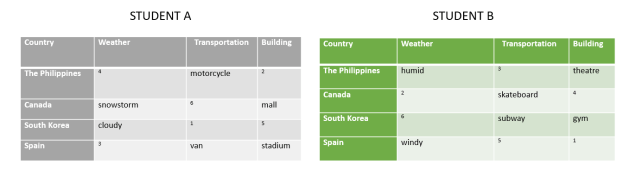
I have found these information-gap chart pair-activities to be a great go-to interactive activity when I’d like to review and reinforce vocabulary words and conversation strategies. And best of all, they are quite easy to make and customize.

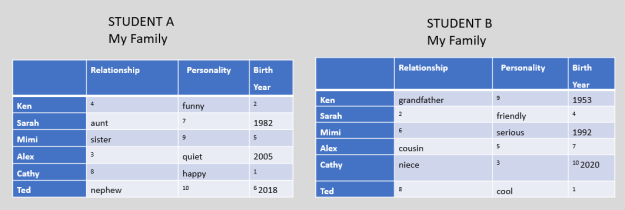
In my previous posting, PART 1, I shared a chart in which the categories were:

Relationship         Personality         Birth Year
Cover Info Part 1 shot

See • Getting The Most Out of Information-Gap Chart Activities PART 1

I had made that one because I wanted to review vocabulary for relationships like cousin, nephew, niece, and aunt, and for personalities like serious, cool, and funny.  Later in the course after students had developed more vocabulary, I revised the chart to so that they could review:

Slide 1 less familiar

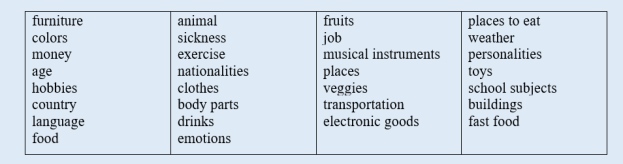
I’ve also made charts that included some of these categories:
Slide 2 categories

Here are two sites that have been helpful for the vocabulary in these categories:

Continue reading →

• Creating Positive Tension during Group Work

Cover tension in group work

 I’ve gained important perspectives from students over the years. The following insight was shared with me by a student after a group-work activity, and it altered how I organized groups.

Typically, during my first year of teaching ESL, when I wanted students to get with a partner or form groups of three or four, I instructed them to do that and let them choose whomever they wanted to work with. However, early in my second year, this happened.

Continue reading →

• LINCS Discussion about Student-Centered Conversation Lessons.

Cover revised post discussion

Cover for Blog posting day 1

If you’d like to read the discussion about teaching conversation skills on LINCS, in which I was “interviewed” through posted Q & A for Dec. 6-9, here is the link: LINCS discussion about student-centered conversation lesson. 

David Kehe

• Starting and Ending a Conversation (Includes a Group Mixer Activity)

Cover Lrg start conv shot

(This posting includes a POWERPOINT presentation and HANDOUTS which you are welcome to use with your students.)*

For the readers of my article in The Word, here is the link to the activity:  NEW Start & End Conv Activity   Also, to see the new, 2026 edition of Conversation Strategies where this activity came from, see Conversation Strategies 2026 Edition

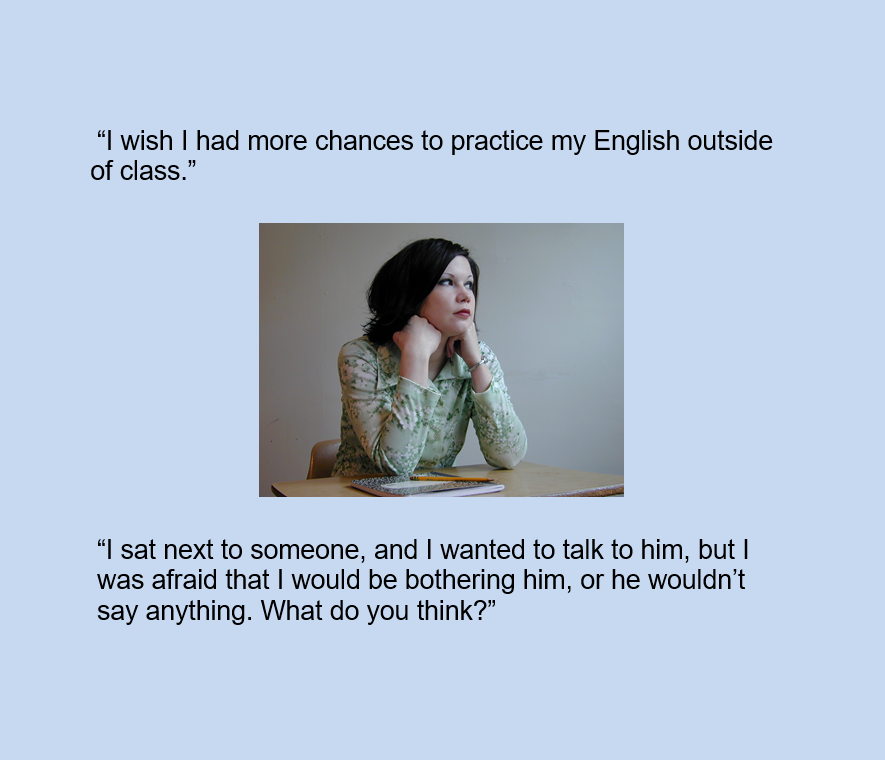
“I wish I had more chances to practice my English outside of class.”

“How can I meet some native-English speakers?”

“I went to a party last weekend. There were about 20 people there, but nobody seemed to want to talk to me. I just kind of stood in the corner looking at my cell phone. Why didn’t anyone talk to me?”

“I sat next to someone, and I wanted to talk to him, but I was afraid that I would be bothering him, or he wouldn’t say anything. What do you think?”

I’ve been asked these types of questions frequently by my students.  Naturally, some of them were low-level students with little confidence in their skills, but surprisingly, often more fluent ones also asked me for advice.

For students from some cultures, starting a conversation with someone they don’t know might be a new concept to them. (See Best Subject for an ESL Integrated-Skills Class (Part 2 of 4: Reading aspect) 

Exercises for starting-a-conversation skills Continue reading →