Category Archives: • Lower & Intermediate Levels

• Effective Two-Way Tasks at Higher as Well as Lower and Intermediate Levels

Cover 2 way SHOT

(This posting includes a handout which you are welcome to use with your students.)*

This posting is an updated version of a post from Feb. 2, 2017: Conversation class: Necessary ingredients for successful pair work (from research)

Early in my career, I became a big fan of two-way tasks in my lower- and intermediate-level Conversation classes.

After several terms of teaching those levels, I was assigned to teach an Advanced Discussion class for the first time. In keeping with the spirit of student-centered teaching, I (as the teacher) wanted to avoid being the one to lead the discussions, so I put students in groups with a list of questions to discuss. However, I soon realized that some students were sitting passively and others tended to monolog.

Then I had an epiphany. By applying the two-way task principle to discussions, I could assure that every student would be equally active.

Basically, each student in a group is given different information. For discussions, every group has a Student A, B and C (and sometimes D and E) and the discussion questions are divided among them. Just as in a two-way task activity, this requires every group member to be involved in asking the questions, in active listening and responding.

For sample activities of how a variation of the two-way-task format can be applied to discussion, see *ESL Discussions: Free Small-Group Discussion Units

We can also use this format to help Advanced-level student develop discussion skills such as:

Continue reading →

• LINCS Topic 2 What instructional strategies have you found to be motivating for English learners? 

Cover Motive Blog June 2023 REV

(This posting includes a handout which you are welcome to use with your students.) 

This posting is a more detailed response to my interview question on Day 2 .LINCS Discussion: Student-Centered Approach to Teaching Writing Skills. .

Below in blue, you’ll find the details that I’ve added to the Day 2 LINCS’ posting.

I have found six ways to motivate students.

1) Give Students Autonomy

According to psychologist Edward Deci, the most important ingredient for motivating students is autonomy. 1

Having autonomy doesn’t mean that students decide what is taught in a lesson.  Instead, students can experience autonomy if the lesson is set up so that they can individually choose which exercise to do first, second etc., how fast to work, when to ask the teacher a question or for help and even when to take a break.

A writing-workshop approach is an excellent way to give students autonomy. Here is how it can be done:

Step 1) The teacher briefly explains the assignments that student will be working on during the class.

Step 2) S/he returns any homework assignment that students had turned in and which the teacher had marked. They will correct these and show the teacher, but they DO NOT start writing yet.

Step 3) If there is a group-activity, the students do that.  As each group finishes, they don’t have to wait for the others to finish.  Instead, they start the assignments from Steps 1 and 2 individually.

Step 4) AUTONOMY!  Students start the assignments by individually choosing which one they want to do first, second, third.   At any time, they can ask the teacher any questions they might have and show him/her corrections from the returned assignment.

Some of the benefits of the Workshop

Continue reading →

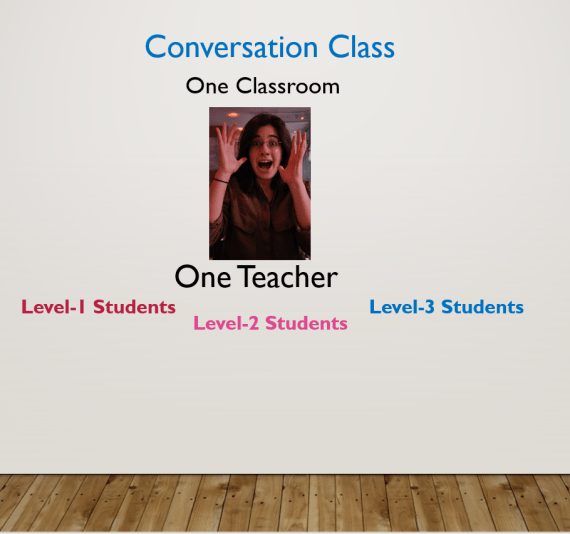
• Meeting A Conversation Course Challenge: Three Levels of Students, One Classroom, One Teacher

Cover multi level Shot

Having three levels of students in one classroom can be overwhelming. But for a reading-skills or writing-skills course, it seems relatively do-able because students can work individually on the reading or writing tasks.

However, for a conversation course in which students need to be interacting with classmates, it’s impossible right? No, it’s definitely possible.

Here is how it has been done successfully with a user-friendly approach for the teacher and with students developing their skills as they would in a single-level class.

Continue reading →

• DON’T Teach This as an ESL Speaking Skill

Reduced Forms 2 Cover shot

(This posting includes a handout which you are welcome to use with your students and a link to a video.) *

In the video, I explain how ESL teachers can best help their students deal with reduced forms of speech. Some examples of reduced forms are
• whaddya (what are you)
• gonna (going to)
• din (didn’t)
• isn (isn’t)
•  cha > / t / + you) > I want you to start now.

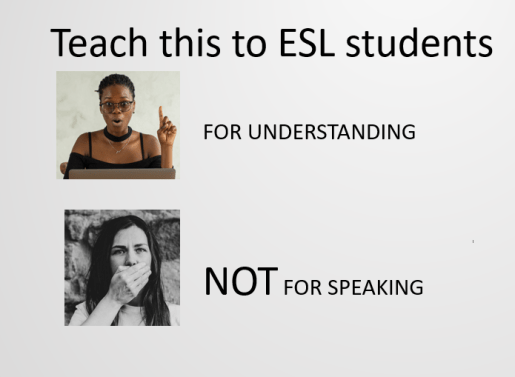
It’s vital that we help students UNDERSTAND what OTHER PEOPLE are saying when they use these, but it’s COUNTER-PRODUCTIVE to tell students to use these when they speak.

The link to the video and two handout-activities

Continue reading →