Category Archives: • Lower & Intermediate Levels

• Discussion Technique to Get Quiet Students Involved (Part 1)

Quiet students Part 2 Cover shot

(This posting includes a handout which you are welcome to use with your students.)*

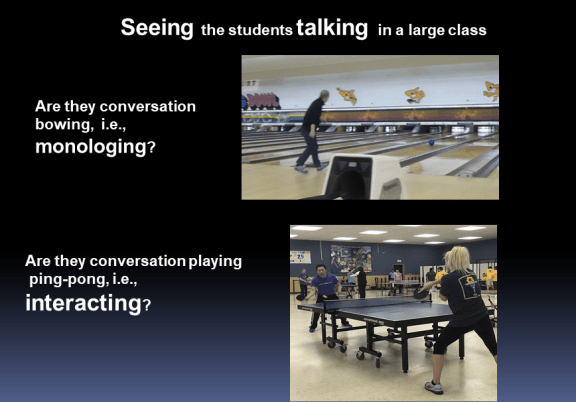
There are techniques which guarantee that all students will be engaged in a discussion.  In other words, the discussion will look like a game of table tennsi, in which students react and respond to what their group members have said.  It doesn’t look like bowling, in which one member tell his/her opinion, followed by a second member, then by a third etc., without necessarily even listening to the other members.

Some of the techniques that compel students to listen to each other and actively interact are:

  • asking follow-up questions
  • seeking and giving clarification
  • using comprehension checks
  • soliciting more details from others
  • interrupting others during a discussion
  • helping the leader of a discussion

A great technique to practice early in a discussion course is “seeking and giving clarifications.”  This involves using expressions such “Did you say …?”  “I didn’t understand …”  “Can you explain … more?”

After students have used the two attached handout-activities, they usually find the technique to be a “tool” that they can use not only in group discussions but also when interacting with teachers and others outside the classroom.

Continue reading

• Making the Perfect Mixture of Structure and Autonomy in Conversation Activities (Customizing Exercises)

Cover SIM shot

(This posting includes a handout which you are welcome to use with your students.)*

YouTube This posting is discussed on my YouTube video:   Perfect Mixture Structure and Autonomy

“Ms. Brown, do we really have to do anything we want to do again today?”**  Ms. Brown is probably an extreme case of instructors who try to give their students autonomy because they believe students know best what they are interested in.

The chances are that you are from a different culture, different generation and/or different socio-economic group from your students.  You probably have a different marital status, different interests and/or different goals.  So how can you tap into what will be most stimulating for your students to talk about when they are practicing conversational techniques?  In other words, how can you customize the exercise for your current group of students?

A key phrase in the question is “conversational techniques.”  Students should be learning techniques that they can apply in conversational situations.  Some technique examples are: beginning a conversation, giving understanding responses, clarifying something, politely interrupting someone, rephrasing something, soliciting details, giving opinions, summarizing what was said, ending a conversation.

Let’s say Ms. Brown wants her students to practice giving opinions.  To customize the activity, she tells the students to think of topics that are interesting to them, get into groups and tell their opinions.  But, without any kind of structure, the students will probably just take turns monologuing, not actually engaging in a conversation.

The “perfect mix” of structure and customizing involves three parts:

Continue reading

• Fun and Student-Centered Speaking/Listening Activity: Truth or Lie

owl and hat

The owl and the hat

One of my students, Sebastian, told our Conversation class this experience: “I was on a hike in the Hundred Acre Woods (a forest near campus).  It was a beautiful morning.  The sun was shining through the tree branches.  Suddenly, I heard a wooshing sound near my head.  Something attacked my head.  And then my hat was gone.  I looked up and notice an owl flying away with my hat.

Then Sebastian left the room, and Kenji came in and told this experience:  “One day, I was walking in the Hundred Acre Woods.  I had a small backpack with my lunch in it.  I was wearing a jacket and a baseball hat.  All of a sudden, I heard a sound near my head, and before I could look up, an owl took my hat and flew away with it.”

Which of these students, Sebastian or Kenji actually had this experience?  Finding this out is the goal of this “Truth or Lie” game.  The students love it.

Continue reading

• Great Self-Study Conversation Technique: Not an Oxymoron

transcribing

Self-study conversation technique

When I was living in Japan and in Africa, I occasionally met a non-native English speaker who spoke almost fluent English with clear pronunciation, natural intonation and mature vocabulary and had great listening skills.  Naturally, I assumed that they must have spent time in an English-speaking country or had English-speaking friends or a tutor, but all of them told me that they had never left their country and had little contact with English speakers.  However, I soon learned that all of them had one thing in common: each of them had developed their oral skills through one fairly simple technique.

Continue reading