Category Archives: • Advanced & High-Intermediate Levels

•ESL Student-Presentations (Part 1): Questioning the Reasons for Doing Them

Ink Cover presentation whole class

Our ESL program faced a mystery. For a couple of terms, students going from Conversation Level 3 (intermediate) to Level 4 (high-intermediate) were struggling with demonstrating basic conversation skills and some needed to repeat the course.

To analyze the problem, the Level 4 teacher recorded students in pairs and triads during an activity in which they were supposed to discuss a topic like “weekend plans,” “having kids in the future,” “social media,” and “emotions.” Then she showed the recordings to a small group of teachers, and we all noticed the same thing: the students weren’t actually interacting by asking a question, answering with some details, giving understanding responses or asking for clarifications and asking follow-up questions. Those are the skills that were supposed to have been introduced in Level 2 and reinforced in Level 3. Instead, those students tended to read from their paper a question which the partner(s) responded to briefly before reading the next question.

We asked the Level 3 teacher if he was surprised by his former students’ performance on these recordings. He said that he wasn’t too surprised because he had only spent half the term working on those skills, and during the other half of the term, he had them prepare and give presentations. His reasons, he told us, were based on his assumptions about the importance of doing presentations and also from some internet and YouTube sites promoting them.

This situation gave us an opportunity to re-evaluate our course goals and the basis for those. During our discussion, we examined the common assumptions for why teachers assign student-presentations.

Assumption 1: Presentations are an essential part of preparing ESL students to succeed in college course.  They are useful since students will surely have to make presentations in other classes, in college, and/or in their future jobs. In other words, ESL students should experience giving presentations because in 5 or 6 months from now when they are in mainstream classes, it is assumed that they’ll be giving presentations.

Response: To find out how true this assumption is, it’s helpful to learn what college instructors actually say.

Continue reading

• DON’T Teach This as an ESL Speaking Skill

Reduced Forms 2 Cover shot

(This posting includes a handout which you are welcome to use with your students and a link to a video.) *

In the video, I explain how ESL teachers can best help their students deal with reduced forms of speech. Some examples of reduced forms are
• whaddya (what are you)
• gonna (going to)
• din (didn’t)
• isn (isn’t)
•  cha > / t / + you) > I want you to start now.

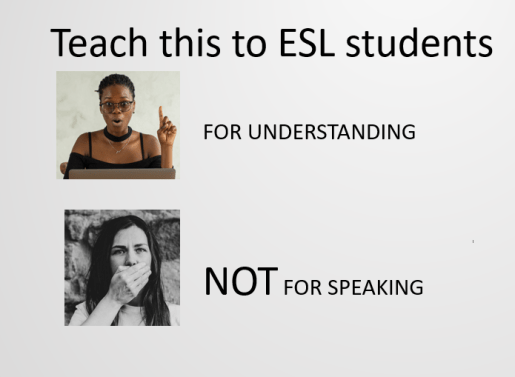
It’s vital that we help students UNDERSTAND what OTHER PEOPLE are saying when they use these, but it’s COUNTER-PRODUCTIVE to tell students to use these when they speak.

The link to the video and two handout-activities

Continue reading

• Creating Positive Tension during Group Work

Cover tension in group work

 I’ve gained important perspectives from students over the years. The following insight was shared with me by a student after a group-work activity, and it altered how I organized groups.

Typically, during my first year of teaching ESL, when I wanted students to get with a partner or form groups of three or four, I instructed them to do that and let them choose whomever they wanted to work with. However, early in my second year, this happened.

Continue reading

• IMPROVING Six Popular ESL Activities: Making Them More Than Just Talking PART 2

Cover Pt 2 shot

In this Part 2 of IMPROVING Six Popular ESL Activities, I’ll discuss how three popular activities are traditionally used and ways that they can be made more stimulating and conducive to conversation-skills development. Here is the link to Part 1. How to IMPROVE Six Popular ESL Activities: Making Them More Than Just Talking PART 1

 Activity 4: Desert Island

Desert Is 1 shot

Desert Is 2 RE Rev shot

Desert Is 3 shot

RECOMMENDATION: It’s helpful to tell students a day or two in advance that they will be doing this activity so that they have time to think about the items that they would want to take in their cars.

Her is a link to a short video where you can see a demonstration of how this “better” activity works and more explanation about its many improvements over traditional Desert Island: A Better Way to do Desert Island

Activity 5: Ask a Partner Questions

Continue reading