Category Archives: • Advanced & High-Intermediate Levels

• Guaranteed Active Whole-Class Discussions (2nd Technique: Volunteering to Answer)

Class discussion

As mentioned in the previous posting “1st Technique: Responding to others,” Guaranteed Active Whole-Class Discussions (First Technique: Responding to Others)  whole-class discussions can be an alien concept to some students.   This is the second technique.

International students in Western-style classes often feel ignored during whole-class discussions if the instructor doesn’t directly call on them.  In some of the classes, instructors expect students to freely offer their comments or ask question.  Also, some hesitate to call on International students because they think those students might feel uncomfortable speaking to the whole class.

This technique, Volunteering an Answer, is very effective in helping even passive students involved in whole-class discussion, and in the process, impressing their instructors.

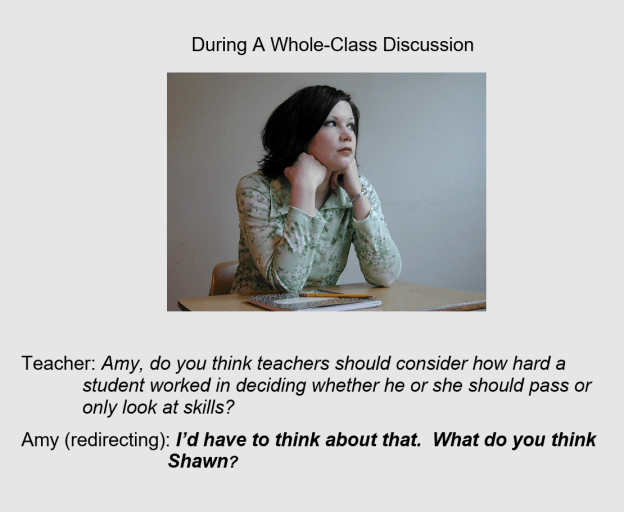
To help you students become comfortable with this technique, you can use the attached script, which I’ll explain about below.  (Notice: for this technique, there is no handout for the student, just a teacher’s script.)

Continue reading

• Guaranteed Active Whole-Class Discussions (First Technique: Responding to Others)

Class discussion

(This posting includes a handout which you are welcome to use with your students.) 

During a whole-class discussion, one of the students, Santos, made a comment.

Then Mai said, “I’d like to ask Santos a question …”

After Santos answered Maria’s question, Lan gave her opinion, and Camilo replied, “Lan said something very interesting …

These students were employing a discussion technique “Responding to Others,” which had taken just 10 minutes for them to pick up.

The concept of whole-class discussions can be an alien one to students from non-Western countries. Students are told that participation in class discussions is expected in Western academic settings and that if they are active participants, it can affect their grade in a positive way. Nevertheless, these students don’t know what “active participation” means, other than to state one’s opinion.  For instructors preparing students for mainstream, academic coursework, the techniques introduced in these next postings could help students develop five specific techniques that they can apply to be active.  

                                  Five Techniques
Responding to another student’s comment
Volunteering an answer
Redirecting a question when you don’t know what to say
Reporting what someone else has said
Summarizing what other group members have said

An additional benefit to those students who employ these is that their classmates will feel good about them and future instructors will be impressed.  For research about this, see  Want Your Students to Seem More Likeable? Research Says: Teach Them Follow-up Questions

The first technique and handout is explained below:

Continue reading

• Want Your Students to Seem More Likeable? Research Says: Teach Them Follow-up Questions

Likeable

(This posting includes a handout which you are welcome to use with your students.) ,*

This could be one of the most useful researched-backed techniques that your students can learn.  If they want to make a positive impression on others during a conversation, they should ask a lot of questions, especially a lot of follow-up questions.

Karen Huang and her research team at the Harvard Business School analyzed more than 300 online and face-to-face conversations between people getting to know each other.  In one study, participants engaged in a 15-minute conversation with a randomly assigned person.  Some of the participants were told to ask many questions (at least nine) and others were told to ask few questions (less than four).  After the conversations ended, the participants told the researchers how much they liked their conversation partner.  The results showed that the people who asked more follow-up questions were considered more likeable.

A second study and activity for students continues below.

Continue reading

• For Large-Class Conversation Instructors, You Can “See” if Students are Using Techniques

Cover seeing shot

(This posting includes a handout which you are welcome to use with your students.)

You,the conversation teacher, are happy because the noise level in the room is high.  That means that the 12 pairs of students (24 total) are engaged in the conversation activity.   At the start of the next class, you want to give them feedback on their performance today, especially because you want to give positive comments to those who are very active.  There are also a couple of pairs who need some “re-direction.”

Needless to say, you’re not going to be able to give each student specific feedback specifically on what they said because you can’t actually hear them above all the talking.  But you can actually see whether or not they are using conversational techniques.

(See previous posts of two important techniques Conversation magic: Two most important conversation techniques (Part 1) and Conversation magic: Two most important techniques. (Part 2)

Even if you can’t hear them, you can see if they are engaging in a natural conversation; it looks like ping-pong, in which they are reacting to each other, asking follow-up questions and giving understanding responses.  You can also see if they are more like bowling, in which one monologs for a while while the other “zones out,” then the other monologs.  You can see if someone is dominating and if someone is very passive.  Interestingly, you can even see if they have switch from English to their native language; often when they do this, their voices lower and their faces aren’t as animated perhaps to “hide” from the instructor.

If you suspect that a pair isn’t using natural conversation techniques or isn’t speaking in English, there are things that you can do.

Continue reading