Category Archives: • During Class

• One of the Worst Mistakes Conversation Teachers Make

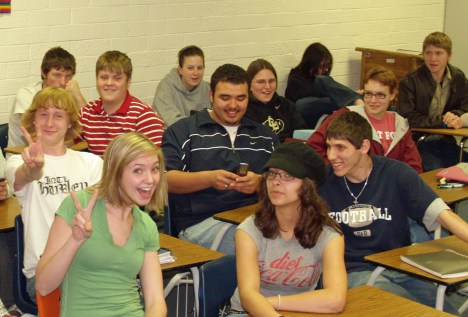
Cover worst mistake conv shot

For some strange reason, some ESL instructors think they can improve any activity by making it as some kind of competition between students or between groups.  Unfortunately, doing this can be counterproductive and actually discourage the most serious students.

To illustrate, consider an information-gap activity like the one from a previous posting Another Conversation Activity: Listen to Partner and Ask Questions to Complete Information-Gap Chart  In this, pairs of students fill in missing information in a schedule by talking, asking questions, and using clarification strategies.

Imagine the teacher tells the students that he will give a prize to the pair who finishes the schedule first.  This is what will happen and how students will miss out on the skills that the activity is meant to develop.

Continue reading

• Advice: Don’t Say These 4 Things to Your Students

Cover Advice don't say these 4 things shot

YouTube This posting is discussed on my YouTube video Don’t Say These 4 Things to Your ESL Students

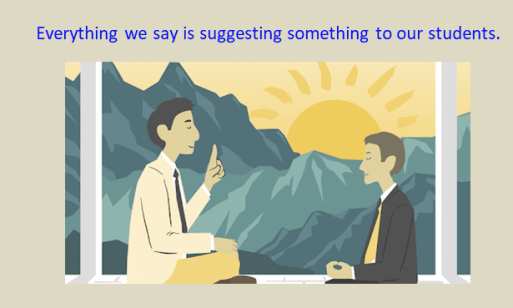
Everything that we say to our students can have a big impact.  For us ESL instructors that can be exhilarating, but it’s also a big responsibility.  Unfortunately, without realizing it, some instructors are sending the wrong message to students with “innocent” comments.  These are four statements that are in this category.

1) Teacher’s statement: The teacher doesn’t want students to feel stress, so just before handing out the quiz, she says, “This quiz will be easy.”
Message that students get: If a student starts the quiz and notices that it isn’t easy, he’s likely to think, “Wow!  I must be stupid.  This quiz is supposed to be easy.  My classmates probably know all this.”
What the message should be: This is what we can say instead to help them understand the purpose of the quiz: “This quiz will help us see how well you’ve developed your skills so far and what we’ll need to practice more.”

2) Teacher’s statement: The teacher wants to reward students, so he says, “You have all worked so hard this week, so I won’t give you any homework.  I want you all to just enjoy your weekend.”
Message that students get: “Homework is painful.  It just interferes with free time.  It’s best if we can avoid it.”
What the message should be: What we really want to do is give students confidence in our homework assignments, so we can say, “I’ve prepared a homework assignment that will lead you to developing your skills more.  It’s going to help you do well on our assignments  next week and in the class that you will be in next term.”

Continue reading

• Most Important Tool for Managing Classroom Behavior (Case two and Caveat)

Classroom management

“David, Please report to the Director’s office as soon as your class finishes.  He needs to talk to you.”  A program assistant handed me a note with those sentences on it.  Gulp!

In the early 1980s, my wife and I, without much thought, accepted teaching positions on the Greek island of Lesbos.  It was a Greek island, so what could possible go wrong?

It was a prep school that high school students attended in the late afternoons/evenings after high school to study English.  Shortly after arriving, we met one of the teachers whom we were replacing.  He told us that the school had a lot of discipline problems because many of the students didn’t want to be there.  He said that the teacher-turnover was quite high as a result.  In fact, a couple of teacher had just disappeared a few months earlier.

On the first day of class, as we walked down the hallway, we could see students literally chasing each other around the class rooms and jumping on the desks.  My first class was with 16 tenth-grade students.  Although most of the students paid little attention to me but instead continued to chat as I started the lesson, there were three female students sitting in the front row appearing eager to begin.  Those three became the focus of my attention.  Gradually, most of the others started to engage in the lesson, while a couple slept or doodled or looked out the window.

Continue reading

• Most Important Tool for Managing Classroom Behavior (First Case)

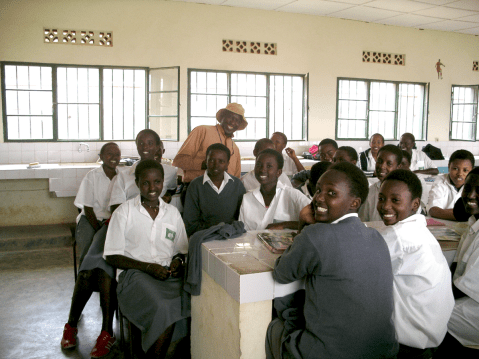
African classroom

(This posting includes a handout which you are welcome to use with your students.)

This “tool” has helped me remain calm in many stressful teaching situations.  Without this, I probably would have changed careers many years ago.  I discovered this tool during my first month of teaching ESL when I was in Africa in the Peace Corps.

Here is what happened that first time in Africa.  One day early in the term, I was conducting a lesson in a class of 35 students.  Sitting in the front row were two popular students, Kato (the class president) and his best friend, Abdula.  They were havig a good time privately whispering and laughing while I was explaining the lesson.  I could tell the other students had noticed them, so I knew I had to do something before the other students would start talking and I’d lose control of the class.  Because Kato and Abdula were popular, I knew that I could alienate the other students if I didn’t handle this situation delicately.  I could feel my stomach churning and blood pressure rising.   Probably many teachers would have had the same initial inclination that I had which would be to just tell them to stop talking.  But what if I did that, and they continued talking?  Then what could I do?   I decided to not say anything right then and to think about it after class.

Continue reading