Tag Archives: handouts

• Missing WHO and WHICH/THAT: Common ESL Problem and Solution (Revisited)

Cover missing who Shot

*(This posting includes a handout which you are welcome to use with your students.)

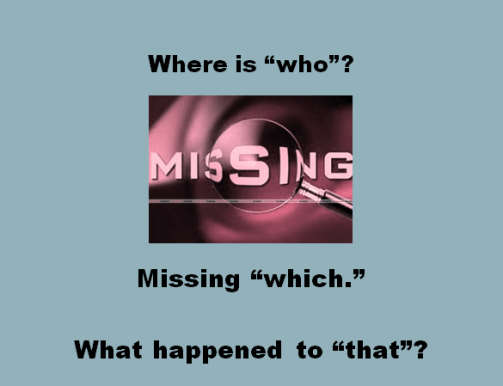
Sometimes I get the feeling that some of my ESL students (including advanced ones) believe that there are a limited number of “who” and “which” out there, and they are afraid of using them all up before they die.

The problem happens when students are trying to write more advanced styles with a dependent and independent clause in a sentence.

Some examples:

Mistake: The people are walking their dogs should keep them on a leash.
Correction: The people WHO are walking their dogs should keep them on a leash.

Mistake: I try to give money to scholarships help low-income students.
Correction: I try to give money to scholarships WHICH help low-income students. *

I’ve also notice that this mistake often happens when students start a sentence with there”.

Mistake: There was an accident happened near my house.
Correction: There was an accident WHICH happened near my house.

* We could substitute the word THAT for WHICH in these sentences.

Solution: Helping students with this. (Handout included.)

Continue reading

• Short, High-Interest Articles for Extensive Reading: #11: “Hidden Tricks for Getting People to do What You Want”

Cover Agreeing

(This posting includes a handout LINK AT THE END OF THIS POST which you are welcome to use with your students.) *

I was totally confused. I saw 18-year-old Ronny walking outside his house carrying a guitar case, but I knew he didn’t play the guitar. I asked him if he was starting to take lessons. He said, “No, but I’m planning to find a date for a party. And I just learned three tricks to do that, and one of them uses a guitar case.” Then he told me about the three interesting experiments.

Researchers sent a very handsome guy to a shopping mall in France to ask women for their phone numbers so that he could call them for a date. He stood in front of different types of stores (for example, a bakery, a shoe store, a café) and as women walked by, he approached them. However, he wasn’t very successful. Only 13% of the women gave him their numbers when he stood in front of those shops. Surprisingly, however, he was twice as successful (26% of the time) in front of one particular shop: a flower shop.

The researchers have a theory about these results. (See complete article below.)

For background information about these articles and for suggestions for how to use them with your students, see  • Introducing “Short, High-Interest Readings”  Also, I’ll be adding more of these articles in the right-hand column: ESL Reading> Short, High Interest Articles for Extensive Readings

Here is the 10th article. You can download the article for your students by clicking on the link at the end. Also included are three optional exercises: True-False Questions; Paraphrasing Exercise; Reflection Exercise.

Continue reading

• Tolerance for Ambiguity in Reading

Cover shot

(This posting includes a handout which you are welcome to use with your students.) *

One of my insecure students, Saki, wrote me this comment at the end of my “Reading Support” class: “I decided to take Psychology next term because of the readings in this course. I now have confidence to read the required “Pharmaceutical” book for me to get a higher paid job as a drug counselor all thanks to this course.”.

Thinking back on the Saki that I remember at the beginning of the class, I’m pretty sure I know what changed for her. I noticed that on her copy of the first article, she had tons of translations, even above words that there was no doubt she would know. She believed that the only way that she could feel confident that she was really understanding a passage was if she knew the meaning of absolutely every word. In other words, she lacked a tolerance for ambiguity.

She told me that she had lost her confidence after looking at the Pharmaceutical course book because there seemed to be so many words she didn’t recognize.

How Saki (and her classmates) gained her confidence by developing a tolerance for ambiguity in everything they read.

Continue reading

• Approaching Grammar with Generation 1.5 Students and Other Ear-Learners (REVISITED)

Cover Gen 1.5

(This posting includes a handout which you are welcome to use with your students.)*

In our college, there was a category of ESL students who stymied the instructors.  They were fluent speakers but continually struggled with basic the grammar on writing tasks.  Any ESL program that has immigrant students will probably have these types of students described as “ear-learners” or Generation 1.5.

Gen 1.5 students are sort of between first generation and second generation immigrant.  They immigrated with their family when they were elementary or high school age.

A growing number of these students indicate a goal of obtaining a college degree.  However, unfortunately, many of them struggle to make the transition from studying basic English skills in ESL courses to taking academic ESL and mainstream academic courses.

Among those who do apply to colleges, a considerable number do not meet the minimum standards for writing and are thus not accepted.

I, along with two colleagues, were able to get a grant a few years ago to study these students and to develop an approach to helping them learn grammar for writing by taking into consideration their special learning styles.

In this posting,

  1. I’ll describe these students and their learning styles.
  2. I’ll also explain the type of materials and include examples that we used with them.
  3. And finally, I’ll summarize the very positive results that we got from the study.

Continue reading