• Another Conversation Activity: Listen to Partner and Ask Questions to Complete Information-Gap Chart

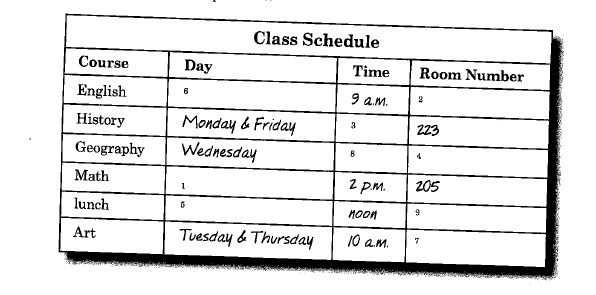
image schedule chart

(This posting includes a handout which you are welcome to use with your students.)*

At first, this pair-work activity looks like it’s about getting students to talk a lot by filling information in a chart.  But that’s not the most important value of it.

Yes, students will talk a lot during this.  But by including a short pre-exercise, they will see how they should ask clarification questions when they need more information or if they didn’t understand.  Asking clarification questions is the strategy that they can use in future conversation situations in and outside the classroom.

In this activity, the students will be filling in information about a class schedule.  They’ll need to listen to their partners tell them the name of courses, days, times and room numbers.  They’ll have many chances to ask questions, especially if they don’t understand.

There are three steps in this activity:

  • Step 1: Brief work with a model showing how to do Step 2.
  • Step 2: Pair activity (Student A/ Student B)
  • Step 3:  Exercise to do if they finish before other pairs have finished.

Continue reading

• Advice: Don’t Say These 4 Things to Your Students

Cover Advice don't say these 4 things shot

YouTube This posting is discussed on my YouTube video Don’t Say These 4 Things to Your ESL Students

Everything that we say to our students can have a big impact.  For us ESL instructors that can be exhilarating, but it’s also a big responsibility.  Unfortunately, without realizing it, some instructors are sending the wrong message to students with “innocent” comments.  These are four statements that are in this category.

1) Teacher’s statement: The teacher doesn’t want students to feel stress, so just before handing out the quiz, she says, “This quiz will be easy.”
Message that students get: If a student starts the quiz and notices that it isn’t easy, he’s likely to think, “Wow!  I must be stupid.  This quiz is supposed to be easy.  My classmates probably know all this.”
What the message should be: This is what we can say instead to help them understand the purpose of the quiz: “This quiz will help us see how well you’ve developed your skills so far and what we’ll need to practice more.”

2) Teacher’s statement: The teacher wants to reward students, so he says, “You have all worked so hard this week, so I won’t give you any homework.  I want you all to just enjoy your weekend.”
Message that students get: “Homework is painful.  It just interferes with free time.  It’s best if we can avoid it.”
What the message should be: What we really want to do is give students confidence in our homework assignments, so we can say, “I’ve prepared a homework assignment that will lead you to developing your skills more.  It’s going to help you do well on our assignments  next week and in the class that you will be in next term.”

Continue reading

• Most Important Motivator of Students: How You Can Use It

Workshop Cover shot

This posting includes sample lessons that give students a lot of autonomy.*

YouTube This posting is discussed on my YouTube video ESL Writing Workshop Approach

The most important ingredient for motivating students is autonomy. 1 The sense of being autonomous can produce a very positive effect on students’ attitude, focus and their performance.  Best of all, it’s very effective and quite easy to include this in ESL classes.

Having autonomy doesn’t mean that students decide what is taught in a lesson.  Instead, students can experience autonomy if the lesson is set up so that they can individually choose which exercise to do first, second etc., how fast to work, when to ask the teacher a question or for help and even when to take a break.

A lesson plan template that gives students autonomy (Writing Workshop)

Teachers can organize their lesson in a Writing Workshop using many different types of materials, but it works best when using inductive exercises.  That is because inductive exercises require little or no time taken up with teacher lectures.

These are General Steps for a Writing Workshop and Sample Specific Lesson with handouts

Continue reading

• Conversation Activity: Stimulating Students to Listen and Respond to Each Other

conversation listen respond

(This posting includes a handout which you are welcome to use with your students.)*

(I discuss this posting in this video:  Stimulating Conversation Activity)

Students are going to make the most progress in their conversation skills if they get into the habit of doing two things:
(1) Listen carefully to what the other person is saying and
(2) Respond to what was said.

This information-gap activity is great practice for a couple of reasons.  First, students will immediately know if they hadn’t understood clearly what their partner had said.  And second, it provides an example of  how to respond to what the partner had said.

There are three exercises in this activity.

Continue reading