Category Archives: 10 ❖ APPLIED PSYCHOLOGY IN TEACHING ESL

• Introverts Find Their Call Teaching ESL

I was ready to start class. Unlike previous days when I left my door open, I slowly closed it because I didn’t want any administrators walking down the halls to see what I was doing with my students. I was afraid that I might get fired.

Continue reading

• Surprising Insight: Avoiding Eye-Contact can Improve Comprehension (REVISITED)

A good reason not to be upset if students don’t look directly at you during a lesson or conversation.

While explaining a writing technique to my students, I noticed that one of them, Emily, was staring off to the side. Thinking that she was daydreaming, I wondered whether I should say her name or ask her a question to “bring her back” to the classroom.

Recently, I learned that I didn’t necessarily need to be concerned about Emily’s lack of eye contact with me. In fact, surprisingly, research suggests that other students might have benefited from doing just what Emily was doing — gazing away from me.

Continue reading

• A Technique For Getting Students To Perform Better On An Assignment (Research Based)

Cover

In a study, researchers used a technique with half the participants but not with the other half (the control group). The results: the ones who experienced the technique made half as many mistakes on the task as the control group.

We teachers could apply a variation of this technique during our lesson-introductions as a way to motivate our students.

Here is how the study was carried out by a psychologist, Dan Ariely. The participants were asked to read words in a room with extremely bright lights. They were all give sunglasses, but half of them were told they were wearing expensive Ray-Ban sunglasses. The other half were told that theirs were just ordinary sunglasses. However, both groups were actually given the exact same type of sunglasses.

The researchers found that the participants who thought they were wearing the Ray-Ban sunglasses read twice as many words correctly as the “ordinary” sunglasses group. Also, they completed the task more quickly.

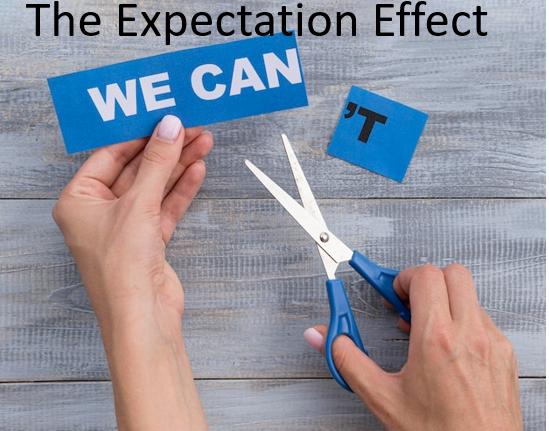
Scientists call this the expectation effect. People tend to perform better when they expect to do so.

In a similar study, half the participant were told that they were going to listen to a task through expensive headphones and half were told they had cheap ones. Actually, all the headphones were the same, but the expensive-headphone group performed much better at identifying distorted words than the cheap-headphone group.

Applying this technique to our classrooms Continue reading

• Most Important Tool for Managing Classroom Behavior (Case two and Caveat) REVISITED

Classroom management

“David, Please report to the Director’s office as soon as your class finishes.  He needs to talk to you.”  A program assistant handed me a note with those sentences on it.  Gulp!

In the early 1980s, my wife and I, without much thought, accepted teaching positions on the Greek island of Lesbos.  It was a Greek island, so what could possible go wrong?

It was a prep school that high school students attended in the late afternoons/evenings after high school to study English.  Shortly after arriving, we met one of the teachers whom we were replacing.  He told us that the school had a lot of discipline problems because many of the students didn’t want to be there.  He said that the teacher-turnover was quite high as a result.  In fact, a couple of teacher had just disappeared a few months earlier.

On the first day of class, as we walked down the hallway, we could see students literally chasing each other around the class rooms and jumping on the desks.  My first class was with 16 tenth-grade students.  Although most of the students paid little attention to me but instead continued to chat as I started the lesson, there were three female students sitting in the front row appearing eager to begin.  Those three became the focus of my attention.  Gradually, most of the others started to engage in the lesson, while a couple slept or doodled or looked out the window.

Continue reading