Category Archives: 03 ❖ ESL GRAMMAR

• Getting Backed Up with ESL Paperwork: Effective Solution

Cover shot

There seems to be certain times during a term when we can feel a bit overwhelmed by the amount of paperwork coming in. During those times, it makes sense to establish some priorities concerning how we approach “marking” the various assignments.

It’s sometimes tempting to rationalize not giving any feedback on or returning some homework assignments by thinking that there are intrinsic benefits for students to just do the exercises. We say to ourselves that it’s not absolutely vital that they get them back quickly (or even, in some cases, ever). Thus, we might consider doing a “triage” with assignments. Essays might get top priority for our time and attention with “lesser” assignments just filed away or held off until sometime in the future when we are all caught up.

Surprisingly, this feeling of being overwhelmed can actually open up a motivation to respond to homework assignments in a way that is more effective than how we would “normally” do it when we have plenty of time.

Continue reading

• LINCS Topic 5: What are your recommendations for teaching writing to higher-level learners who have academic goals?

Cover 5 higher levels REV

 (This posting includes a handout which you are welcome to use with your students.) 

This posting is a more detailed response to my interview question on Day 5 .LINCS Discussion: Student-Centered Approach to Teaching Writing Skills. .

Below in blue, you’ll find the details that I’ve added to the Day 5 LINCS’ posting.

My top recommendation is to develop a clear understanding of the type of writing students will do in English Comp and academic class after they leave our classes.

With this as our starting point, we can apply our knowledge of language learning to help them develop the skills they will need.

In a survey of 360 college faculty members (of mainstream courses), it was found that, when asked to prioritize the most important components of an effective piece of writing produced by their ESOL students, the respondents chose, as their top three priorities (1) organizing content to express major and supporting ideas, (2) using relevant examples, and (3) demonstrating command of standard written English (Hinkel, 2004). 

I have found similar results from my face-to-face interviews of more than 40 mainstream college instructors in 8 different subject areas who assign papers in their first-year courses. Ten of these were English Comp instructors.

Here are some recommendations based on research.

Continue reading

• Memorizing: Not the Optimal Approach to Learning ESL

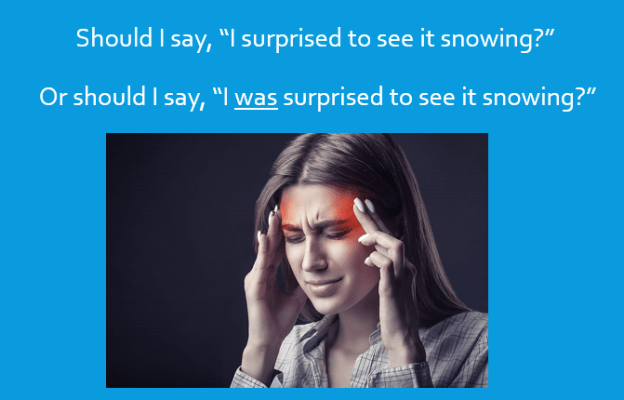
Cover surprised shot

(This posting includes a handout which you are welcome to use with your students.)*

This posting is an update of a post from September 2019: Mistake: He surprised to see it snowing. (Adjectives that look like verbs)

Back in my high school days, learning my first foreign language, French, I remember often hearing the teacher say, “You’ll just need to memorize this.”

Fortunately, the art of teaching foreign languages, including ESL, has come a long way from those “just memorizing” days. We understand the importance of comprehensible input and the effectiveness of engaging with new concepts and vocabulary in multiple contexts.

To illustrate this, I’d like to refer to a posting from 2019, in which I discussed a common mistake that ESL students make with adjectives that look like verbs. Instead of telling students that they need to memorize these words, we lead them to internalizing these though a series of four exercises. By the end of these, students tend to remember because the words“sound” right rather than wracking their brains searching for what they had been told.

When students see an –ed at the end of a word, they tend to automatically assume it’s a verb, and this assumption can lead them to grammar mistakes.

(* mistakes—These sentences are missing a verb.)
*Kai embarrassed during his speech.
* Rumi interested in horses.

To help students in the most efficient manner, I will sometimes paint with a broad brush.  So I simply tell my students that these words are adjectives: surprised, embarrassed, confused, interested and shocked. They need a verb with them.

(correct): Kai was (v) embarrassed (adj) during his speech.

Avoiding unnecessarily complicated information

It’s true that those words can be can be used as verbs, for example:
– It embarrassed (v)  Kai that he forgot some of his speech.

But in all my years of teaching writing, I rarely see students use them that way. They almost always use them as adjectives, so I don’t waste their time/mental energy talking to them about using these as verbs. Instead, I just generalize and tell them that they are adjectives.

Four-step exercises to teach these to students (Handout included.)

Continue reading

• The Power of Listening Input for Language Learners

Cover pt lover revised

(True story.) It’s the September of 1985, the year that Stevie Wonder released an international hit song. I’m on campus in Japan and happen to run into a couple of my students from spring term, Yuki and Hana.

“How was your summer?” I ask.

“Wonderful! I went to Europe with my family,” Yuki says.

“That’s great! How about you Hana?”

“Interesting. I had a part-time lover,” Hana answers.

Both Yuki and I look astonished and laughingly ask simultaneously, “You had a what?!!”

“I had a part-time lover. … Oh, no, I mean I had a part-time job!” Hana replies with some embarrassment when she realizes what she had said.

She then explains how she had often heard Stevie Wonder’s “Part-Time Lover” during the summer.

Hana’s automatic response to my question demonstrated the power of listening input. Since then, I’ve found ways to tap into it’s potential in helping student internalize grammar concepts and new vocabulary, and even how to write paragraphs and essays.

Continue reading