Category Archives: Making teachers’ lives better

• Don’t Wastes Students’ Energy Teaching Certain Types of Vocabulary Words in Reading Class (Revisited)

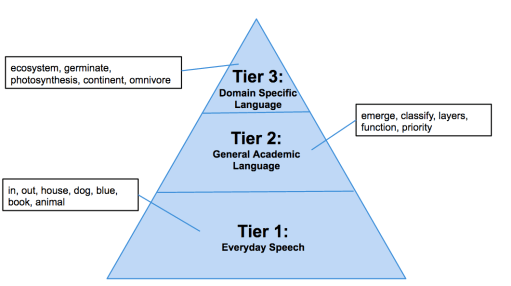
Three Tiers

“Radiance,” “strike a deal,” “gorgeous” “ecosystem.” In my 40 years of teaching academic ESL, I’ve probably seen these word in a reading passage at most only once or twice.  And I’ve never seen a student use them in a writing task.  And yet, these words were  included in several vocabulary exercises in a textbook, and students were asked to write sentences with them.  Because the words were in a reading passage, the author of the textbook, for some reason, decided that these were important words for students to study and try to internalize.

I think most of us would agree that spending time on words so rarely used as “radiance” or “strike a deal” is probably not the best use of students’ precious time and mental energy if our true goal is to help them develop their reading skills.  At the same time, many of us who have studied a foreign language would agree that reading comprehension is enhanced by knowledge of a lot of vocabulary words.

At this point, two questions come to mind: (1) How do learners increase their vocabulary, and (2) which vocabulary words would perhaps be beneficial to study through exercises?


Continue reading →

• Introverts Find Their Call Teaching ESL

I was ready to start class. Unlike previous days when I left my door open, I slowly closed it because I didn’t want any administrators walking down the halls to see what I was doing with my students. I was afraid that I might get fired.

Continue reading →

• Surprising Insight: Avoiding Eye-Contact can Improve Comprehension (REVISITED)

A good reason not to be upset if students don’t look directly at you during a lesson or conversation.

While explaining a writing technique to my students, I noticed that one of them, Emily, was staring off to the side. Thinking that she was daydreaming, I wondered whether I should say her name or ask her a question to “bring her back” to the classroom.

Recently, I learned that I didn’t necessarily need to be concerned about Emily’s lack of eye contact with me. In fact, surprisingly, research suggests that other students might have benefited from doing just what Emily was doing — gazing away from me.

Continue reading →

• Pain-Free ESL Speaking Placement-Testing Process: Reliable, Time-Efficient and User-Friendly REVISITED

Cover ppt shot

(This posting includes a handout which you are welcome to use with your colleagues.)*

At first, all the teachers wanted to administer the oral test for placing students into one of the four levels of conversation classes. But that enthusiasm waned once they discovered what this commercially-made placement test would entail.

Two major problems with many speaking placement tests (commercial and in-house)

1)  The testing process in labor intensive. The scoring rubrics are onerous, ineffective and require time-consuming training.

2)  Rather than just focusing on the skills being developed in speaking/conversation classes, the interviewers have to evaluate several peripheral aspects of speaking at the same time.

A Speaking Placement-Testing Process That Addresses Those Problems.

Continue reading →