Tag Archives: activities

• Another Conversation Activity: Listen to Partner and Ask Questions to Complete Information-Gap Chart

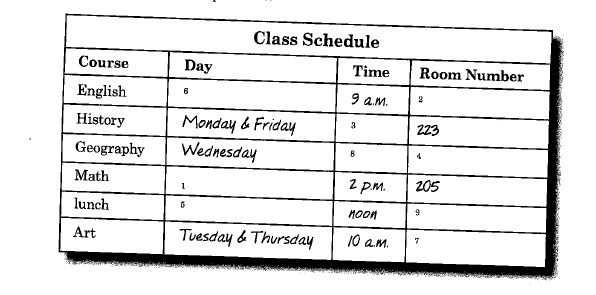
image schedule chart

(This posting includes a handout which you are welcome to use with your students.)*

At first, this pair-work activity looks like it’s about getting students to talk a lot by filling information in a chart.  But that’s not the most important value of it.

Yes, students will talk a lot during this.  But by including a short pre-exercise, they will see how they should ask clarification questions when they need more information or if they didn’t understand.  Asking clarification questions is the strategy that they can use in future conversation situations in and outside the classroom.

In this activity, the students will be filling in information about a class schedule.  They’ll need to listen to their partners tell them the name of courses, days, times and room numbers.  They’ll have many chances to ask questions, especially if they don’t understand.

There are three steps in this activity:

  • Step 1: Brief work with a model showing how to do Step 2.
  • Step 2: Pair activity (Student A/ Student B)
  • Step 3:  Exercise to do if they finish before other pairs have finished.

Continue reading

• The Huge Advantage International Student Writers Have Over Their American Classmates

COVER REV shot

(This posting includes a handout which you are welcome to use with your students.)*

YouTube This posting is discussed on my YouTube video  Huge Advantage International Student Writers Have Over Their American Classmates—A Writing Technique

It can be liberating to ESL students to realize that almost anything that they can include in their essays/papers about their culture and country will probably be interesting to their American instructors.  This is a great advantage that they have over their American classmates.

However, just encouraging them to include this kind of information in their essays often results in paragraphs like this one from an essay about raising children:

In addition to teaching skills, parents sometimes need to discipline a child who misbehaves. Some people will spank their children in order to get their attention and redirect them.  However, in my country, parents very rarely do this.

The writer did include information from his country, but he missed an opportunity to exploit this information and make it more remarkable.  After being asked for more details, the writer revised the end of the paragraph:

… However, in my country, parents very rarely do this.  Instead, if a child refuses to listen to his mother or throws a tantrum, his mother will tell him to stand outside the house. The worse thing that can happen to someone in my culture is to be excluded from the group, so this type of punishment can be very effective.

An Inductive Approach to Teaching this Technique (and handout exercises)

Continue reading

• Taking TPR to Another Level of Engagement: Two Fun Lower-Level Activities (Part 2: Movie Directors)

Excerpt from directors’ script:

Movie Director script

(This posting includes a handout which you are welcome to use with your students.)*

This activity is not only great for skill building, but also offers an opportunity for students to be creative.  It’s also very entertaining and a complete change from other activities that students usually do in class.

After students have done the TPR (Total Physical Response) activity which I had describe in Part 1 , Taking TPR to Another Level of Involvement: Two Fun Lower-Level Activities (Part 1: Triads) they’ll be prepared for this one, “Movie Directors.”

In brief, these are the steps and the handout.

Continue reading

• Taking TPR to Another Level of Involvement: Two Fun Lower-Level Activities (Part 1: Triads)

Excerpt from Student A’s paper:

Image St A soup

(This posting includes a handout which you are welcome to use with your students.)*

This activity will show how TPR (Total Physical Response) can be more student-centered than the traditional teacher-directed approach.  Also, it is a pre-step to the TPR activity “Movie Directors,” which I’ll share in the next posting .

In this activity, students are put in groups of three (Students A, B, C).  Each member is given a paper with different “commands.”  They read their commands to their partners, who listen and do the actions.

Continue reading