Category Archives: • Lower & Intermediate Levels

• Conversation Activity: Getting Students to Say More Than the Minimum

Cover more than minimum Shot

(This posting includes a handout which you are welcome to use with your students.)*

 We might think that the students who say little in a conversation are lazy or just quiet by nature.  That’s not necessarily the case.  Some students have told us that they are trying to be polite and let others talk.  Others just don’t know what to say, so they say the minimum.  And some just aren’t aware that they should speak more.

This activity is designed to help these types of students. It “gives permission” to the polite students to talk more.  It “requires” the lazy or quiet ones to contribute to the conversation.  And it “pushes” everyone to think of something, anything, to say.

The activity is call Responding with Details. In groups of three, students ask each other the supplied questions (in a Student A, B, C format).  Every time the members respond, they have to answer with “and, but, so, because or with two sentences.

Example

  1. Marit: Where was the best place you ever lived?
  2. Lucien: I like warm weather, so I really loved living in California. (Answered with “so”.)
  3. Marit: When did you live there?
  4. Lucien: When I was in high school.  We moved there when I was 16 and stayed for three years. (Answered with two sentences and “and.”)

Steps in the activity (and the handout)

Continue reading

• Another Conversation Activity: Listen to Partner and Ask Questions to Complete Information-Gap Chart

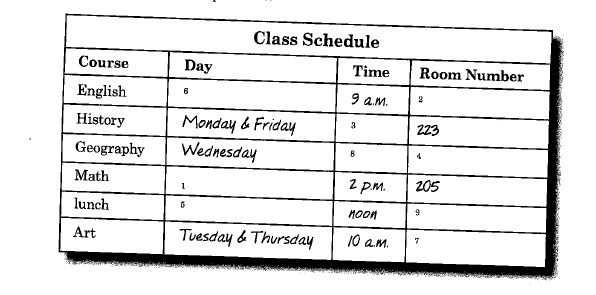
image schedule chart

(This posting includes a handout which you are welcome to use with your students.)*

At first, this pair-work activity looks like it’s about getting students to talk a lot by filling information in a chart.  But that’s not the most important value of it.

Yes, students will talk a lot during this.  But by including a short pre-exercise, they will see how they should ask clarification questions when they need more information or if they didn’t understand.  Asking clarification questions is the strategy that they can use in future conversation situations in and outside the classroom.

In this activity, the students will be filling in information about a class schedule.  They’ll need to listen to their partners tell them the name of courses, days, times and room numbers.  They’ll have many chances to ask questions, especially if they don’t understand.

There are three steps in this activity:

  • Step 1: Brief work with a model showing how to do Step 2.
  • Step 2: Pair activity (Student A/ Student B)
  • Step 3:  Exercise to do if they finish before other pairs have finished.

Continue reading

• Conversation Activity: Stimulating Students to Listen and Respond to Each Other

conversation listen respond

(This posting includes a handout which you are welcome to use with your students.)*

(I discuss this posting in this video:  Stimulating Conversation Activity)

Students are going to make the most progress in their conversation skills if they get into the habit of doing two things:
(1) Listen carefully to what the other person is saying and
(2) Respond to what was said.

This information-gap activity is great practice for a couple of reasons.  First, students will immediately know if they hadn’t understood clearly what their partner had said.  And second, it provides an example of  how to respond to what the partner had said.

There are three exercises in this activity.

Continue reading

• Taking TPR to Another Level of Engagement: Two Fun Lower-Level Activities (Part 2: Movie Directors)

Excerpt from directors’ script:

Movie Director script

(This posting includes a handout which you are welcome to use with your students.)*

This activity is not only great for skill building, but also offers an opportunity for students to be creative.  It’s also very entertaining and a complete change from other activities that students usually do in class.

After students have done the TPR (Total Physical Response) activity which I had describe in Part 1 , Taking TPR to Another Level of Involvement: Two Fun Lower-Level Activities (Part 1: Triads) they’ll be prepared for this one, “Movie Directors.”

In brief, these are the steps and the handout.

Continue reading