Category Archives: Making teachers’ lives better

• This Process Contains Huge Benefits For Writing Teachers, Students and Programs.

Cover panel NO MORE shot

The reason why this process is so powerful is that it resolves all these troublesome situations:

Situation 1) Teachers are disappointed by the writing skills of students being promoted to their classes.
A Level 4 teacher has discovered early in a term that some of the students in the Writing class who were promoted by a teacher at a lower level (Level 3) do not have the necessary writing skills to perform well at that level. Often it results in a tense conversation like this:

Level 4 Teacher: “I have one of your students from last term, Fidi, in my Level 4 class.  His writing is very weak. I wonder how he was able to pass your class.”
Level 3 Teacher: “Yes, I know he’s not really good. When he came to my class from Level 2, his skills weren’t very good. But he did all the assignments and tried very hard. So I didn’t feel like I could justify failing him.”

Situation 2) Students feel they weren’t treated fairly because the teacher didn’t like them.
A student who failed his Writing course complains to the director that the reason why he failed was because the teacher didn’t like him, not because he had poor writing skills.

Situation 3) Teachers burn out from teaching Writing classes due to excessive record keeping.
Writing teachers readily accept the fact that these courses involve reading/marking a lot of papers. However, what often overwhelms them the most is having to count up points for every assignment and keep records of these.

Situation 4) Students quibble with the teacher over points on a writing assignment.
A student receives 83 out of 100 points on an essay and argues with the teacher that he should have gotten 86 points. 

Situation 5) Students who fail the Writing class beg the teachers to change their grade because of the personal hardships failing would cause them.


Student
: “Could you please, please let me pass this class? My parents don’t have a lot of money, and I might have to leave this school if I fail. I’ll work hard at the next level. I know I can do well in it.”

Here is the process that is the remedy for all those situations.

Continue reading

• Making It Easier For Your Colleagues And Students To Agree With You.

I could see from my roster for the upcoming term that the infamous Eddie would soon be attending my Advanced ESL Writing class. Eddie was slowly making his way through our academic ESL program and was well-known for his sense of humor and for continually arriving late to class. Having heard from his previous teachers about the unsuccessful strategies they had tried to use to get him to come on time, I decided to try a different approach.

Coincidentally, around this time, I was preparing to make a proposal to our program director and instructors and was trying to decide how best to present it. To get our Writing Course students to read more, I decide to recommend that we assign them to read for an hour a week and write a brief reading journal.  And in order to not add more work for the teachers, I was hoping we could hire a person or two be a “Reading Journal Reader” who would read and write comments on the journals.  (For more details about using a “Reading Journal Reader,” see One of Best Uses of an ESL Program’s Funds—And a Giant Help to Teachers. )

Fortunately, I had recently listened to Psychologist Adam Grant’s podcast “Worklife” in which he tells about a skill we can use when we’re trying to initiate a request.  It’s counter-intuitive, but I’ve found, it’s quite effective.

Continue reading

• Avoiding Writing-Teacher Burnout: Save Your Time And Energy With This Effective Method For Giving Specific Feedback.

Many teachers mistakenly believe that spending their precious time and energy writing long comments at the end of students’ papers is what Writing teachers should do.  As one instructor wrote in The Chronicle of Higher Education: “I am an English professor, and responding to student writing is what we English professors do…For 25 years, I have diligently, thoughtfully, and fastidiously written comments on my students’ essays. In my neatest hand, I’ve inscribed a running commentary down the margin of page after page, and at an essay’s conclusion I’ve summarized my thoughts in a paragraph or more.”

This instructor decided to stop writing comments on her students’ paper after she came to this realization: “Most students seemed to spend little time taking in my comments on their papers. They quickly skimmed, looking for the grade, and then shoved the papers into their bags.” Her solution: Instead of writing comments, she decided to meet in her office to discuss her students’ papers one-on-one.

For most ESL Writing instructors, meeting with students in their offices is not a realistic option. At the same time, writing long comments at the end of papers is often a waste of time and energy, just as that professor discovered.

It seems that there are two approaches to giving feedback to each student

General Feedback Approach

Part of problem with giving general feedback at the end of an essay is that the comments tend to be so generalized that there is little for students to apply to future writing assignments.  For example, here is what one teacher wrote:

Continue reading

• Enjoyable and Effective Awareness Activity for Changing ESL Students Classroom Behavior

Cover skits Shot

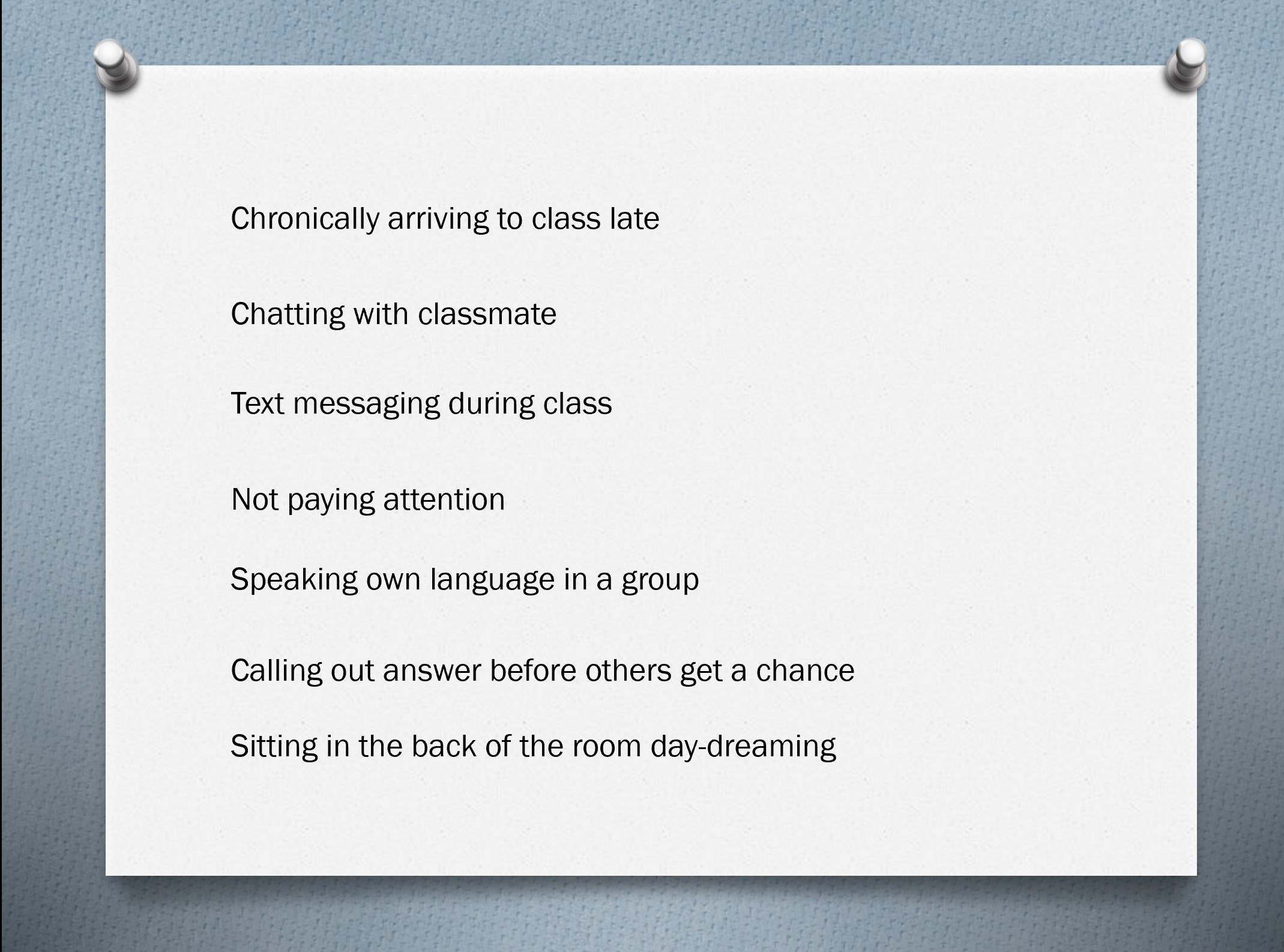
Most ESL students don’t do goofy things just to irritate the teacher. Usually, they are unaware of how they are coming across or not aware that they are acting differently from the other students or even what is expected of them.  These are some of the habits students tend to bring to our classes:

  • Chronically arriving to class late
  • Text messaging during class
  • Not paying attention
  • Chatting with classmate
  • Not participating in a group
  • Calling out answer before others get a chance
  • Sitting in the back of the room day-dreaming
  • No eye contact to teacher or classmates in a group
  • Speaking own language in a group
  • And more

To circumvent these habits and help students develop an awareness of expectations, in the two most recent ESL programs that I’ve taught in, we included some skits during our orientation of new students or during a workshop for students after the term had started. Not only did the students seem to enjoy them, but also we noticed far fewer students coming to our classes with these behaviors.

Here is how we did it.

Continue reading